REVIEW · BARCELONA
Private Barcelona Old Town Walking Tour: Gothic Quarter & Born
Book on Viator →Operated by PHOTO EBIKE TOUR BARCELONA · Bookable on Viator
Barcelona’s old streets feel like a time machine.
This private Gothic Quarter & Born walking tour strings together big-name landmarks and lesser-seen corners in about 3 hours, with an English-speaking guide who keeps the pace moving. I especially like how the route gives you a fast sense of layout—from Plaza de Catalunya to Las Ramblas to the Roman layers underneath—without turning it into a checklist.
Two things I really value: the guide’s friendly, energetic explanations (Alfredo is specifically praised for making history feel human), and the way the walk ends on the Born side so you can keep exploring or grab dessert right after. The only real catch is timing and entries: a couple of stops list admission as not included, so you’ll want to decide on the spot if you want to pay extra to go inside.
In This Review
- Key Highlights You’ll Feel Right Away
- Getting Your Bearings: Gothic Quarter to Born in Three Hours
- Where the Tour Starts (and Why That Location Works)
- Stop-by-Stop: From Plaza de Catalunya to Las Ramblas
- Entering the Gothic Layers: Santa Maria del Pi, The Call, and Roman Remains
- Cathedral, Royal Power, and the Civic Heart
- Castellers and Plaça Reial: Catalonia’s Living Tradition
- Basílica de Santa Maria del Mar and the Born Neighborhood Food Scene
- What Makes Alfredo’s Style Matter (Not Just the Sights)
- Price and Value: Is $180.04 Worth It?
- Logistics to Keep Your Day Smooth
- Who Should Book This Gothic Quarter and Born Walk?
- Should You Book This Tour?
- FAQ
- Where does the tour start?
- What time does the tour begin?
- How long is the walking tour?
- Is this a private tour?
- Is the tour offered in English?
- How much does it cost?
- Is a service animal allowed?
- Are tickets included for every stop?
- Can I cancel and get a full refund?
Key Highlights You’ll Feel Right Away
- Private tour, only your group, with an English guide and a mobile ticket
- 3 hours with tight routing from Gothic landmarks to Born neighborhoods
- Roman to medieval to Spanish civic life, including the Roman wall entrance and Royal Palace area
- Jewish quarter and wartime memory at the Call de Barcelona and Plaça de Sant Felip Neri
- Gaudí details on the ground, including the famous street lamps at Plaça Reial
- A smart finish at Mercat del Born, with Hofmann pastry as the final treat
Getting Your Bearings: Gothic Quarter to Born in Three Hours
If Barcelona is your first time city, this kind of route is gold. You don’t just see famous places—you understand how the city grew: starting at the grand civic spine (Plaza de Catalunya), moving down to the classic boulevard link (Las Ramblas), then slipping into older neighborhoods where Roman, medieval, and later Catalan identity all overlap.
The tour runs about 3 hours and is private, so you’re not stuck behind a crowd. That matters in Barcelona’s Old Town, where the streets can feel tight and slow. Here, the schedule keeps you moving while still giving you short stops to look closely and absorb what’s around you.
It’s also in English, and the ticket is mobile, which helps on a day when you’d rather be walking than digging through printed confirmations.
You can also read our reviews of more walking tours in Barcelona



Where the Tour Starts (and Why That Location Works)
You meet at Apple Passeig de Gràcia (Pg. de Gràcia, 1), in the Eixample area, right at the heart of the city’s main shopping-and-avenues zone. Starting here is practical. You get dropped into the central flow immediately, and it’s easy to reach by public transportation.
From there, you begin at Plaza de Catalunya, the classic crossroads square. It’s not the most dramatic stop, but it’s the best launch pad. Your guide briefs you in a way that helps everything after make sense—streets, neighborhoods, and why certain places matter.
The tour also starts at 4:00 pm. Late afternoon is often a good window for Old Town walking: you’re usually past the loudest daytime crush, and the light can make stone and façades look more cinematic.
Stop-by-Stop: From Plaza de Catalunya to Las Ramblas
This portion is all about the spine of the city, the “connector” streets that tell you where Barcelona’s energy concentrates.
- Plaza de Catalunya: a quick orientation briefing in the central square.
- Las Ramblas: one of Barcelona’s most important streets, described here as the link between the newer city and the port. Even if you’ve seen photos, walking it helps you understand how the city funnels visitors and locals alike.
- Font de Canaletes: the fountain tied to Barça celebrations. It’s a fun pause that also anchors you in Barcelona’s pop culture identity.
- Mercat de la Boqueria: the famous market on Las Ramblas. This isn’t just “food tourism.” Markets like this explain everyday Barcelona—vendors, stalls, and the city’s taste habits.
- Carrer de Petritxol: the well-known Street of Chocolate. It’s short, but it gives you that Old Town whimsy you expect in the Gothic-adjacent lanes.
This mid-section is a good mix of iconic and quick. If you want to take photos, you’ll find enough micro-moments to do it without derailing the pace.
Entering the Gothic Layers: Santa Maria del Pi, The Call, and Roman Remains
After the Ramblas-to-lanes transition, the tour starts reading the city like a timeline.
- Basílica de Santa Maria del Pi: a famed basilica stop. Note that admission is marked as not included, so you may choose to view from outside or decide on entry if you want it. Either way, it’s a strong Gothic-era anchor.
- Call de Barcelona (Jewish area): you’ll walk through the Jewish quarter within the Gothic area. The stop is short, but the point is understanding how neighborhoods were shaped by different communities over time.
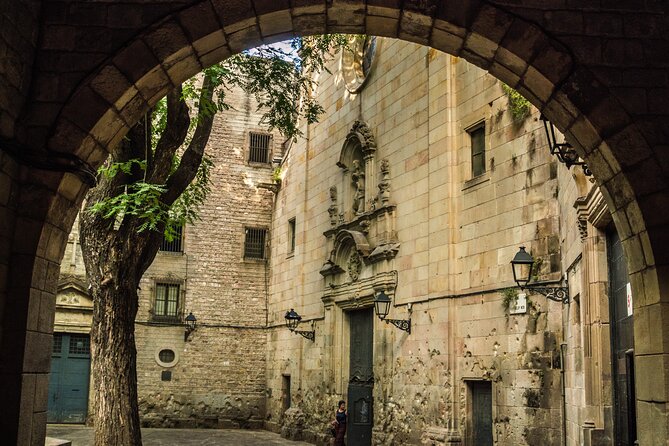
- Plaça de Sant Felip Neri: a pretty square with a heavier note—traces from bombing in 1938. This is one of those moments where the guide’s context matters, because the square’s beauty can mask the historic weight unless someone explains it.
Then the tour shifts into Roman Barcelona—important because it reminds you the city isn’t just medieval. It’s built on older foundations.
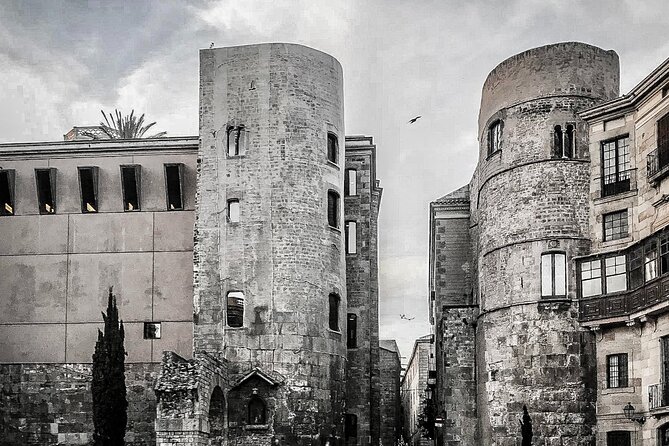
- Roman city wall entrance: you’ll see the Roman entry of the city.
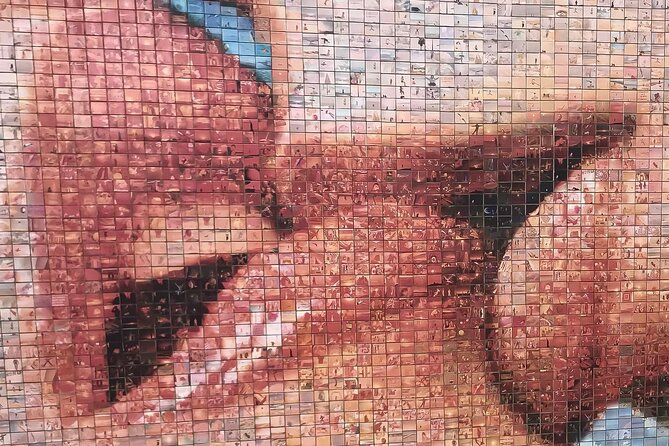
- Plaça d’Isidre Nonell: a quick stop at a mosaic called The Kiss. Small, visual, and memorable.
Cathedral, Royal Power, and the Civic Heart
Next comes the “power places.” In Barcelona’s Old Town, these buildings aren’t just pretty. They show who ran the city, how authority worked, and how different eras left their fingerprints.
- Cathedral of Barcelona: a brief, high-impact stop.
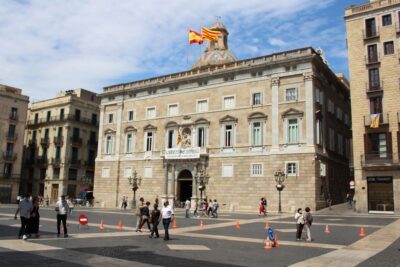
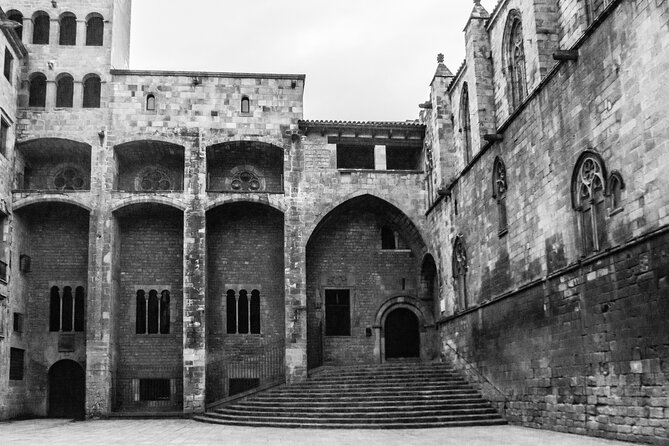
- Plaça del Rei: a monumental square surrounded by Gothic and Renaissance buildings, linked to the Royal Palace area—residence and seat of government for the Counts of Barcelona and the Kings of Aragon.
- MUHBA (Museu d’Historia de Barcelona): you’ll reach this museum focused on Roman ruins, with a note that admission is not included. The tour keeps the museum stop short, but the message is clear: there’s a whole layer under your feet, and you can choose whether to pay to go deeper.
After that, you continue toward Catalan civic life with more Roman-to-modern continuity.
- Centre Excursionista de Catalunya: noted for the four Roman-period columns (Temple of Augustus).
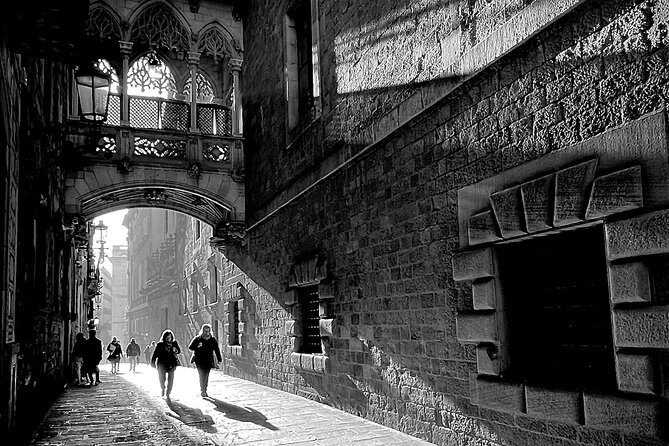
- Pont del Bisbe: one of Barcelona’s most photographed bridges, plus local secrets and legends.
- City Hall (Casa de la Ciutat / Ayuntamiento) and Palau de la Generalitat de Catalunya: both quick but meaningful for understanding the city’s governance.
You can also read our reviews of more private tours in Barcelona



Castellers and Plaça Reial: Catalonia’s Living Tradition
If you like culture that’s not just museum-sized, you’ll appreciate this segment.
- Monument als Castellers: a homage to Castellers, Catalonia’s human towers tradition. It’s a reminder that identity here isn’t frozen in stone. It’s practiced—day-to-day, season-to-season.
Then you move to a square that blends architecture, design, and that “Barcelona after work” feel.
- Plaça Reial: a beautiful connector between the Gothic area and Las Ramblas, with Gaudí street lamps described here as among his earliest works. This is the kind of stop where the details reward you—look up, not just ahead.
- Plaça d’George Orwell and Plaça dels Traginers: both short, both designed for atmosphere. Plaça dels Traginers includes an old Roman tower you can see from the area, reinforcing the theme: Roman traces keep popping up as you walk.
Basílica de Santa Maria del Mar and the Born Neighborhood Food Scene
Now the tour lands in the Born, a neighborhood that feels more relaxed than the main Ramblas strip while still being central to Old Town life.
- Basílica de Santa Maria del Mar: an important basilica stop. Depending on time, you may be able to go inside. Admission is listed as free, so your choice is about the schedule rather than extra ticket cost on paper.
- Passeig del Born: a nice boulevard in the Born area, giving you a breather after denser stone streets.
- Mercat del Born: an old market that’s now a cultural center because of the ruins you can see underground from the 18th century. This is one of the stops where “Old Town” becomes literal—you can connect the square-level view with what’s below.
Finally, the tour ends with food as a natural payoff.
- Patisserie Hofmann: you’ll finish here, and you can decide whether you want a drink nearby or a dessert from the shop. Ending with something edible is a smart move. You’re tired, you’re happy, and you can keep the evening going without thinking too hard.
What Makes Alfredo’s Style Matter (Not Just the Sights)
The big standouts in the feedback around this tour aren’t only about the buildings. They’re about the guide’s method.
Alfredo is praised for being both professional and fun, and for explaining history with balance—the good, the bad, and the ugly. That’s more than a personality trait. It changes how you remember places. When you hear why a square holds wartime traces, why a palace area became a seat of power, or what a legend attached to a bridge is really pointing at, you don’t just see a postcard. You understand the city’s choices over time.
You’ll also get comparisons using historical documents and pictures as you walk. That’s one of the best ways to make sense of architectural change when you’re moving quickly.
Price and Value: Is $180.04 Worth It?
At $180.04 per person for about 3 hours, this isn’t a bargain-basement walk. But it can still feel like good value if you’re the type who wants context, not just movement.
Here’s what you’re paying for:
- Private format, meaning your group isn’t diluted by others
- An English guide who uses documents/pictures to explain change
- A route that covers a lot of categories: royal power areas, Roman remnants, Jewish quarter context, markets, and civic Catalan sites
- A finishing point that’s useful, not random—Mercat del Born and Hofmann pastry help you keep time for dessert and strolling
What could reduce value for you? If you mostly want photos and minimal talking, a guided historical route might feel like it’s taking too much time at each stop. The itinerary is packed, and it works best when you’re open to short explanations and quick transitions.
Logistics to Keep Your Day Smooth
This tour is built for walking in Old Town. A few practical tips make it easier to enjoy:
- Wear comfortable shoes. The streets are uneven in places, and the schedule is tight.
- Expect some stops to be view-from-outside unless time allows entry. Two key items list admission not included, so plan mentally for optional extras rather than assuming everything is pay-once-all-day.
- Bring something simple for hydration and snack timing. You’ll have market and pastry moments, but you still might want a buffer.
Also, you’re not on your own to interpret addresses across town. You start at a clearly located point and end at Mercat del Born (Plaça Comercial, 12), so the route has a clean shape.
Who Should Book This Gothic Quarter and Born Walk?
You’ll probably love this if:
- You’re seeing Barcelona for the first time and want your bearings fast
- You like history that connects layers—Roman, medieval, and modern civic life
- You want a guide who explains with balance and keeps things upbeat
- You care about neighborhood character, not only headline monuments
You might skip it or look for an alternative if:
- You prefer long self-paced museum time over walking and quick stop explanations
- You don’t want to make choices about whether to pay for entry at a couple of spots
Should You Book This Tour?
I think this one is a strong pick for a first Barcelona visit. It covers the Gothic Quarter and Born in a way that feels designed, not improvised: orientation at Plaza de Catalunya, the Ramblas corridor, Jewish quarter context, Roman traces, royal and civic power spots, then Born’s market-and-basilica rhythm, ending with a real payoff at Hofmann.
If you want a guide-driven route with personality—Alfredo’s described style of mixing facts with honesty—you’ll likely feel it immediately. Just go in knowing that not every stop is a guaranteed inside visit, because a couple of admission items are explicitly not included.
FAQ
Where does the tour start?
It starts at Apple Passeig de Gràcia, Pg. de Gràcia, 1, Eixample, 08007 Barcelona, Spain.
What time does the tour begin?
The start time is 4:00 pm.
How long is the walking tour?
It lasts about 3 hours.
Is this a private tour?
Yes. It’s private, meaning only your group participates.
Is the tour offered in English?
Yes, it’s offered in English.
How much does it cost?
The price is $180.04 per person.
Is a service animal allowed?
Yes, service animals are allowed.
Are tickets included for every stop?
Not always. Admission is listed as not included for Basílica de Santa Maria del Pi and Museu d’Historia de Barcelona (MUHBA). Other stops are listed as free.
Can I cancel and get a full refund?
Yes. You can cancel up to 24 hours in advance for a full refund. If you cancel less than 24 hours before the start time, the amount paid is not refunded.