REVIEW · BARCELONA
Tarragona and Sitges Tour with Small Group and Hotel Pick Up
Book on Viator →Operated by In Out Barcelona Tours · Bookable on Viator
Two Catalan towns, one unforgettable full day. I love the convenience of hotel pickup and the big payoff of UNESCO Roman Tarragona, then you roll straight into the sea-town mood of Sitges. It’s a great way to see more of Catalonia without losing half the day to planning or parking.
The tradeoff: this is a long day with lots of uneven streets and stairs, especially around the Roman sites. If knees or hips are an issue, plan for slower pacing and extra rests.
In This Review
- Key reasons this tour earns repeat bookings
- Tarragona and Sitges: the smart day trip pairing
- Morning pickup and the Barcelona viewpoints you pass on the way out
- Pont del Diable and the UNESCO core of Tarragona
- Pont del Diable: the aqueduct that still looks impossible
- Tarragona Old Town: narrow lanes and the right kind of wandering
- The amphitheater: where public spectacle happened
- Murallas de Tarragona: city walls that still show the timeline
- Cathedral and other city symbols
- Markets, museum stops, and the Tarraco model that makes sense of it all
- Mercado Central: the city’s everyday heartbeat
- Museum area and the Tarraco Model
- Sitges walking tour: modernism, beach-town charm, and Casa Bacardi
- Casa Bacardi and modernist architecture
- Optional food breaks and how the guide helps
- San Sebastián urban beach: the break that makes the whole day feel worth it
- Sant Bartomeu & Santa Tecla: the photo spot with real payoff
- Why small-group size (max 8) changes how the day feels
- Walking stamina and comfort tips (this is where you win or lose)
- Price and value: what you’re really paying for at $120.29
- Who should book this Tarragona and Sitges day trip
- Should you book this Tarragona and Sitges tour?
- FAQ
- How long is the Tarragona and Sitges tour?
- What’s the price per person?
- Do you get hotel pickup in Barcelona?
- What group size is this tour?
- Is the tour offered in English?
- Are tickets to Tarragona’s amphitheater included?
- Is entrance to Tarragona Circus included too?
- Do you have time to enjoy San Sebastián Beach in Sitges?
- Is lunch included in the price?
Key reasons this tour earns repeat bookings
- Door-to-door pickup in Barcelona: you start right from your hotel or apartment, generally between 8 and 9 am.
- UNESCO Tarragona in one focused route: aqueduct (Pont del Diable), amphitheater, walls, and old-town walks.
- Real beach time in Sitges: take a break at San Sebastián urban beach, or just enjoy the terrace views.
- Small group capped at 8: easier conversations, less shuffling, and more guide attention.
- Entrances included for major Roman stops: the Tarragona amphitheater and the Roman events venue (Tarragona Circus).
- Guides with personality and strong stories: names like Ramon, Miquel, Luis, Eduardo, Diego, and Lluís Goula come up again and again for upbeat, clear explanations.
Tarragona and Sitges: the smart day trip pairing
If you only have a short window outside Barcelona, this is one of the cleaner choices. You get UNESCO World Heritage Tarragona first, then you end in the relaxed, artsy atmosphere of Sitges. That contrast matters. It’s not just “another town visit.” It’s ancient power and daily life on one side, then Mediterranean calm and modern Catalan culture on the other.
I also like that the day is built to reduce friction. With pickup and a driver, you don’t have to time public transport or rent a car. You just show up, meet your guide, and move through each place in a logical order.
The pacing is active, but it’s not chaotic. A good guide can turn a lot of walking into something that feels organized, not exhausting.
You can also read our reviews of more tours and experiences in Barcelona.


Morning pickup and the Barcelona viewpoints you pass on the way out
Your day starts where it matters: right at your Barcelona accommodation. Pickup runs between 8 and 9 am, and the operator sends your exact pickup time, guide name, and a phone number the day before. That’s genuinely helpful if you’re staying in a busy area and don’t want to guess where a tour van will stop.
Before the drive south, you also get a quick orientation of central Barcelona from the road. Expect to pass major landmarks like Catalunya Square, Barcelona Cathedral, and Passeig de Gracia, with views along the Gaudí axis (including the Batlló and Pedrera buildings). You’re not doing a full Gaudí deep-dive here, but it helps you connect the dots when you’re returning to the city later.
Then you head down the coast, following the Costa Dorada. Even if you’ve already seen Barcelona’s big hitters, this stretch gives you that feeling of leaving the city behind and getting into a slower rhythm.
Pont del Diable and the UNESCO core of Tarragona
Tarragona is not one giant ruin. It’s layers. Roman engineering, city walls, public entertainment, and medieval-era streets all sit in the same walkable system. That’s why this part of the tour feels so satisfying: each stop explains a different function of the old city.
Pont del Diable: the aqueduct that still looks impossible
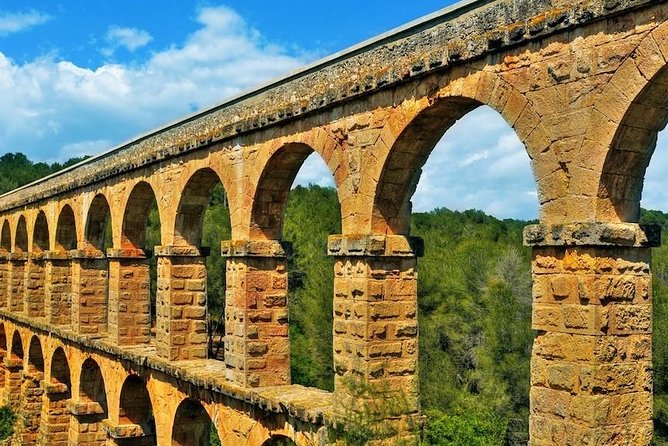
Before you even enter Tarragona’s central areas, you’ll stop for Pont del Diable, also called the Devil’s Bridge. It’s a Roman aqueduct measuring about 217 meters long and 26 meters high (711 feet by 85 feet). And it’s not a tiny photo spot. The scale is the point.
You’ll likely get time for pictures with the aqueduct against the surrounding woodlands. It’s one of those structures where you can almost feel how much planning it took to make water arrive on schedule. The fact that it provided water for centuries (right up until the 18th century) helps the Roman story feel practical, not just dramatic.
Tarragona Old Town: narrow lanes and the right kind of wandering
Next comes a walking section through older Tarragona areas, including Antiga Casa del Consolat Tarragoni. This is where the atmosphere shifts. Instead of monument views, you’re moving through shady squares and cobbled lanes that make it easier to imagine life during Roman and medieval periods.
If you like “small moments” on tours—street layout, street textures, how people used to move through space—this part delivers. If you’re the kind of person who hates getting your feet used as a museum map, just know you’ll need comfortable shoes.


The amphitheater: where public spectacle happened
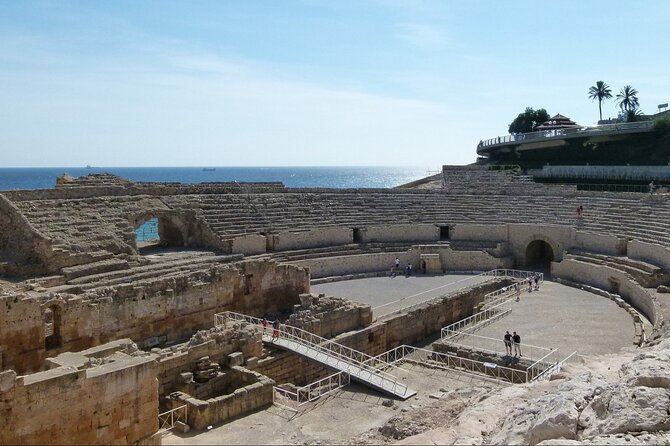
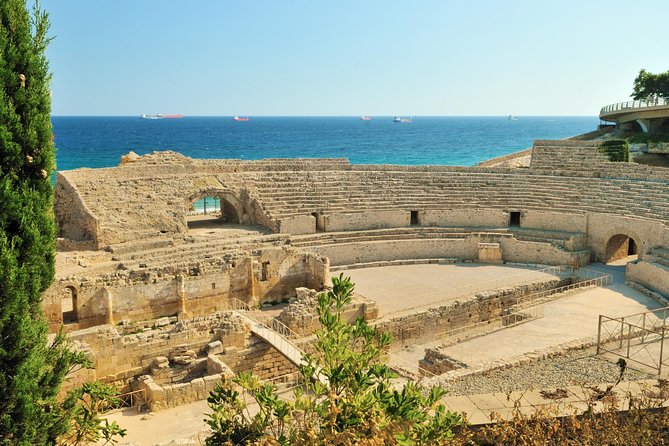
Then you hit one of the big Roman highlights: the Tarragona amphitheater, an important UNESCO-listed site. The amphitheater was carved into the hillside near the sea area around the early 2nd century AD. It was used for events like gladiator contests and public executions, so expect a tone that’s more intense than a cozy history lecture.
Entrance here is included, which matters because it keeps the day moving. Walking into a real performance space always feels more real than looking at ruins from outside.
A practical note: amphitheaters are designed for crowds, but modern visitors often do fine if they take breaks and keep an eye on footing. The ground can be uneven near older structures.
Murallas de Tarragona: city walls that still show the timeline
You’ll also see Murallas de Tarragona, the Roman walls. The tour frames them as among the earliest constructions tied to the original military camp and the period that followed. That’s a useful detail: it gives you a sense that Tarragona’s Roman footprint wasn’t just decorative. It was about control, defense, and organization.
Even when you’re only seeing segments, walls help you understand the city as something people built to survive.
Cathedral and other city symbols
You’ll have a chance to look at the cathedral area, noted as a National Monument and Cultural Good of National Interest. Time here can be limited because the tour is built to cover multiple zones, but it gives you a quick visual reminder that Tarragona keeps evolving.
You’ll also pass a distinctive monument connected to Castellers—Catalan human-tower tradition. The tour highlights a formation with a total of 219 figures, about 11 meters high, and roughly 12 tons. Even if you’ve never watched a human tower event, this is one of those cultural details that makes Tarragona feel unmistakably Catalan.
Markets, museum stops, and the Tarraco model that makes sense of it all
Roman ruins tell you what’s left. Markets and models help you understand what it was like to live there.
Mercado Central: the city’s everyday heartbeat
One of the most grounded stops is Mercat Central. It’s described as basic but beautiful, housed in a Modernist building from 1915 near Rambla Nova. You’ll use this as a “how people ate and lived” bridge between Roman public spaces and later city life.
Even if you don’t plan to buy anything, this stop is valuable because it changes your frame. You stop thinking only about empires and start thinking about supplies, fresh seasonal products, and local routines.
Museum area and the Tarraco Model
You’ll also pass the National Archaeological Museum of Tarragona and learn stories tied to Roman Tarraco and its wider influence. The tour then includes time in front of the Tarraco Model, a scale representation of the city around the 2nd century BC during its maximum splendor.
If you struggle with “Roman ruins = confusing piles of stone,” this is one of the best parts of the day. A model gives your brain something to hang everything on. It helps you connect the amphitheater hillside, the walls, and the shoreline amphitheater context into one city picture.
You also get a mention of the Roman circus venue (Tarragona Circus) through included entrance, which adds another layer beyond the amphitheater. In practice, guides often use these entertainment venues to explain how public events were part of city identity, not just entertainment.
Sitges walking tour: modernism, beach-town charm, and Casa Bacardi
After all that Roman material, Sitges feels like relief and fun. You’ll get a walking tour through the historic center and the winding streets, with time to explore “hidden corners” of town. Expect a more relaxed pace here compared to the Roman sections.
Casa Bacardi and modernist architecture
Sitges has that artistic Catalan vibe where the streets seem to encourage lingering. The tour points you toward modernist architecture, including Casa Bacardi, and touches on the Bacardi family history.
This matters because it explains why Sitges looks the way it does. You’re not just seeing a pretty façade; you’re seeing how the town became a place for artists, social life, and sea-and-mountain style living.
Optional food breaks and how the guide helps
The tour doesn’t include meals, but guides often suggest places to eat on your schedule. You may hear suggestions for a cocktail stop, and you could choose to sip a drink made by bartenders using colorful blended flavors. That’s optional, not required.
If you plan to self-guide your food decisions, this is still useful because you’ll know where the lively areas are and how to plan a lunch stop without turning it into a scavenger hunt.
San Sebastián urban beach: the break that makes the whole day feel worth it
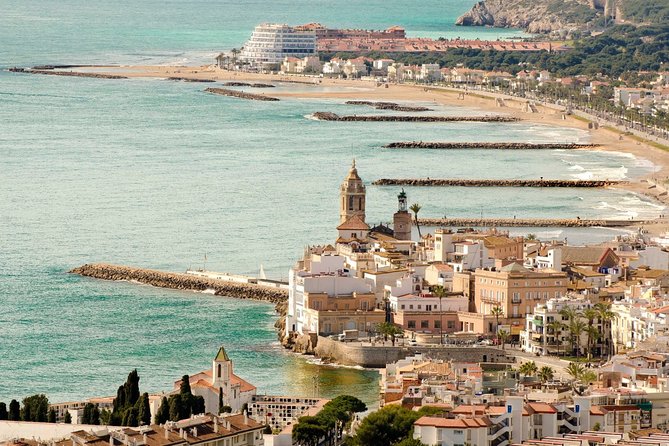
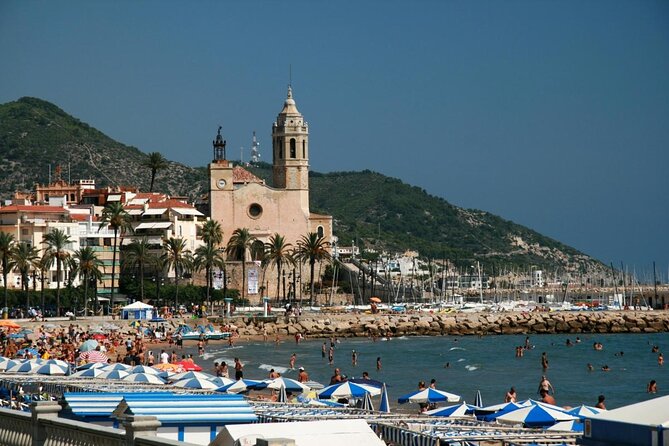
The highlight payoff for many people is the beach time in Sitges at San Sebastián Beach. The tour description notes it as one of the best urban beaches in Europe, and it’s the kind of place where you don’t need a resort mindset. You can just relax, sit on a terrace, and watch the town shift from street life to sea life.
You’ll have a window to either relax or take a dip in the Mediterranean. On sunny days, that simple option changes the mood of the whole day from “museum sprint” to “day trip.”
Sant Bartomeu & Santa Tecla: the photo spot with real payoff
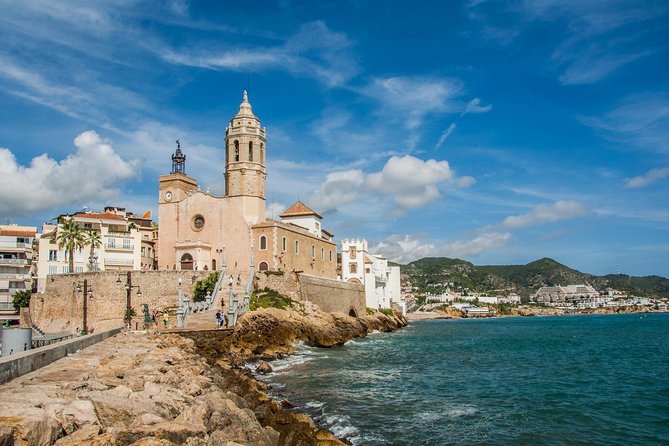
Later in Sitges, you’ll visit the church of Sant Bartomeu & Santa Tecla. It was built in the 17th century and functions as a symbol of the town. More importantly for your photos, it has standout viewpoints.
If you want a clean “end-of-day” scene—sea town rooftops, ocean light, and a view that feels like a postcard—this is one of the best targets.
There’s also time for Playa de Sitges, with a focus on Mediterranean views. If your schedule allows, you can add a quick swim or just enjoy the shoreline scenery.
Why small-group size (max 8) changes how the day feels
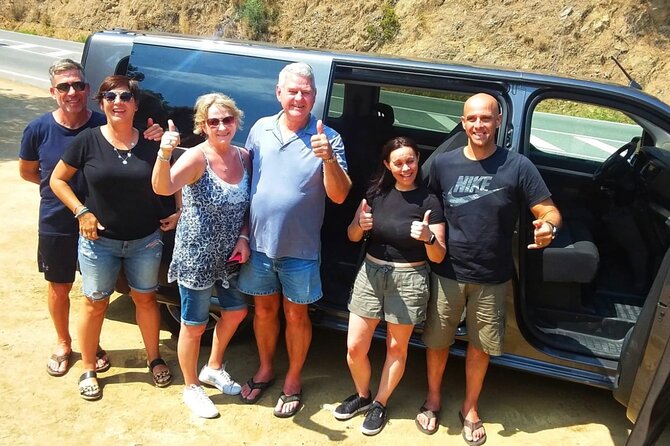
This is a small-group tour capped at 8 people. That sounds like marketing language until you experience it. With fewer people, your guide can slow down for questions without the whole group getting stuck. It also means fewer bottlenecks at narrow corners in Tarragona’s older streets.
In the day-to-day reality, you’ll notice it at stops where people want to ask about what they’re seeing. Guides for this route are repeatedly praised for friendly attention and for making the stories stick. Names that come up include Ramon, Miquel, Luis, Eduardo, Diego, and Lluís Goula, and that mix suggests the company puts real care into who’s teaching the day.
Walking stamina and comfort tips (this is where you win or lose)
A smaller group doesn’t remove the physical side of this itinerary. Expect a lot of walking on uneven surfaces and some stairs at key sites. One review note flagged that it can be risky with sore knees or a bum hip, even with braces.
Here’s how to handle that:
- Wear shoes with good grip and wear them all day, not just for “the big ruins.”
- Take breaks when you need them. Guides can generally be patient, but you’ll do yourself a favor by speaking up early.
- If you know you’ll struggle with stairs, plan to focus on the easiest viewpoints first—like terraces and broad overlooks—then decide how much you push into the deeper ruins areas.
Also keep the day’s feel in mind: it’s history-heavy in the morning and sea-town relaxed in the afternoon. If you pace yourself, the long hours stop feeling like a chore.
Price and value: what you’re really paying for at $120.29
At $120.29 per person for an approximately 10-hour day, the price only makes sense because the tour bundles the big pain points for you:
- Hotel pickup and drop-off in Barcelona city saves time and logistics.
- An air-conditioned vehicle handles the long drive south along the coast.
- You get guided walking in both Tarragona and Sitges, plus entrance to Tarragona’s amphitheater and Tarragona Circus.
- A mobile ticket helps reduce waiting time on-site.
Food and drinks aren’t included. That’s normal for a day trip like this. But it also means you can eat where you want, at a time that fits your energy level.
When the day works well, it feels like you paid for two things: expert guidance through Roman Tarragona and an efficient route that gets you to Sitges without the hassle of driving and parking.
Who should book this Tarragona and Sitges day trip
This is a smart choice if you:
- Want a Tarragona day trip from Barcelona that mixes UNESCO Roman sites with a real coastal-town finish.
- Prefer small-group touring with max 8 people so questions don’t get lost.
- Like a guide who turns ruins into stories you can picture: aqueduct engineering, amphitheater public life, and Roman city layout through the model.
- Want a beach break at San Sebastián Beach as part of the same day plan.
I wouldn’t pick this as your first option if you have strong mobility limits or you know you’ll struggle with stairs and uneven footing. The itinerary covers multiple historic zones, and some stops sit on slopes or uneven ground.
Should you book this Tarragona and Sitges tour?
If you want one full day outside Barcelona that actually combines meaning, scenery, and a tangible payoff at the beach, I think this is worth booking. The mix of UNESCO Tarraco Roman sites and Sitges coastal atmosphere is exactly the kind of pairing that makes a day trip memorable.
Book it if you’re comfortable with a lot of walking and you want door-to-door convenience. Skip it (or plan a different day) if your knees, hips, or stamina need a low-stairs itinerary.
FAQ
How long is the Tarragona and Sitges tour?
The tour runs about 10 hours.
What’s the price per person?
The price is $120.29 per person.
Do you get hotel pickup in Barcelona?
Yes. Pickup and drop-off are included for hotels or apartments in Barcelona city.
What group size is this tour?
It’s a small-group tour with a maximum of 8 people.
Is the tour offered in English?
Yes, the tour is offered in English.
Are tickets to Tarragona’s amphitheater included?
Yes. Entrance to the Tarragona amphitheater is included.
Is entrance to Tarragona Circus included too?
Yes. Entrance to Tarragona Circus (Roman events venue) is included.
Do you have time to enjoy San Sebastián Beach in Sitges?
Yes. The schedule includes time at Playa de Sitges and San Sebastián Beach, with the chance to relax or swim depending on your preferences and timing.
Is lunch included in the price?
No. Food and drinks are not included.