REVIEW · BARCELONA
‘The Cathedral of the Sea’ Walking Book Tour
Book on Viator →Operated by Icono Spain Tours · Bookable on Viator
A good story can change how you see a city. This walking tour turns The Cathedral of the Sea by Ildefonso Falcones into a route you can actually walk, mixing Gothic sights with the book’s characters and social world. I love the clear book-to-street connections at places like Basilica de Santa Maria del Mar, and I also like how the route includes both the political squares of the Gothic Quarter and the Synagoga Major de Barcelona. One thing to consider: the tour’s language experience can be uneven, since I saw mentions of Spanish-heavy commentary when English speakers were mixed in the group.
You’ll cover major medieval backdrops in a compact loop, so you don’t waste a day zigzagging. Plus, with a small cap of 15 travelers, it stays easy to hear your guide when you’re standing in busy plazas.
If you’re mainly chasing architecture facts, this still works. If you want a long, slow, super-detailed site-by-site lecture in perfect English, double-check what you’re booking.
In This Review
- Key moments that make this tour worth your time
- Why The Cathedral of the Sea tour feels different from a standard Gothic walk
- Timing and route basics: 2–2.5 hours, starting at Plaça de Santa Maria
- Stop 1: Basilica de Santa Maria del Mar (the story’s Gothic heartbeat)
- Stop 2: Carrer Montcada and the medieval-to-Baroque “main street” effect
- Stop 3: Placa del Rei—one of the clearest windows into medieval Barcelona
- Stop 4: Placa de Sant Jaume—civic life still runs through the same “lung”
- Stop 5: Synagoga Major de Barcelona and the “calls” of the Jewish Quarter
- Stop 6: Catedral de la Santa Creu i Santa Eulàlia—why going inside changes everything
- Price and value: $17.86 for a focused book-and-city loop
- Language and group mixing: the one thing to watch
- What to bring (and how to plan your day around the walk)
- Who should book this tour
- Should you book the Cathedral of the Sea Walking Book Tour?
- FAQ
- How long is The Cathedral of the Sea walking tour?
- Where does the tour start and end?
- What time does the tour begin?
- What is included in the price?
- Do I need tickets or will I pay extra at the stops?
- Is there a mobile ticket?
- What’s the group size?
- Does the tour run in bad weather?
- Are service animals allowed?
- What’s the cancellation window?
Key moments that make this tour worth your time
- Santa Maria del Mar as the story’s emotional center, with the right Gothic vibe for the book’s world
- Carrer Montcada: noble doorways and old courtyards that explain why this part of Barcelona mattered
- Placa del Rei + Placa Sant Jaume: power in stone, from medieval monarchy space to modern civic life
- Synagoga Major de Barcelona: a major stop for understanding the medieval Jewish Quarter
- Small group size (max 15), which helps your guide manage questions and keep the flow moving
- Book-focused narration that helps you connect characters to real streets and buildings
Why The Cathedral of the Sea tour feels different from a standard Gothic walk
Most Gothic Quarter tours give you architecture first and story second. This one does the opposite—or at least balances it more. The whole point is to pull scenes from Falcones’ debut novel off the page and onto Barcelona’s streets, then anchor them in real medieval spaces.
I especially like how that storytelling approach can make you slow down. Instead of just passing through plazas, you get a reason to look up, notice a doorway, or pay attention to how a square functions. When the tour lines up the book’s conflicts and social tensions with the city’s layout, Barcelona starts to feel less like postcards and more like a lived-in setting.
You can also read our reviews of more walking tours in Barcelona



Timing and route basics: 2–2.5 hours, starting at Plaça de Santa Maria
The tour runs about 2 hours (with some descriptions pointing to roughly 2.5 hours depending on pacing). Either way, it’s a half-morning commitment that fits neatly into a day of museum hopping or beach time afterward.
You start at Plaça de Santa Maria (Ciutat Vella) and end near Plaça Nova (Ciutat Vella). That matters because the middle of the day in the Gothic Quarter can get crowded. By planning around a route that naturally pushes you through the busiest core early, you avoid some of the crush later.
The start time is 10:00 am, and the experience operates in all weather conditions, so plan on it going forward if it’s drizzle, not a storm. Comfortable shoes are a must—this is a walking tour with real standing time.
Group size is capped at 15 travelers, which is a big deal here. In tiny groups, you’re less likely to get parked behind someone tall while the guide talks into the air.
Stop 1: Basilica de Santa Maria del Mar (the story’s Gothic heartbeat)
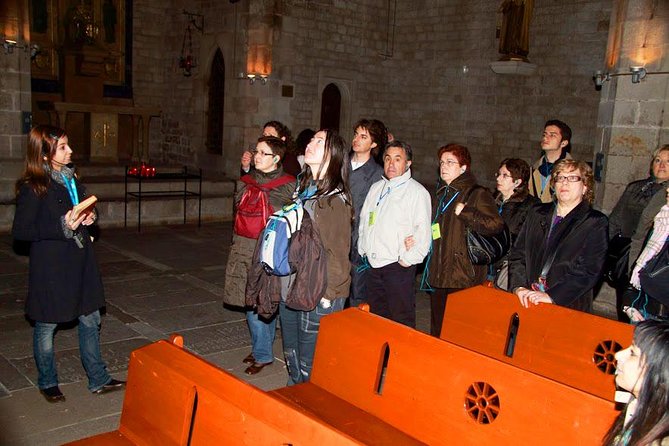
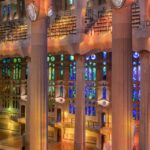
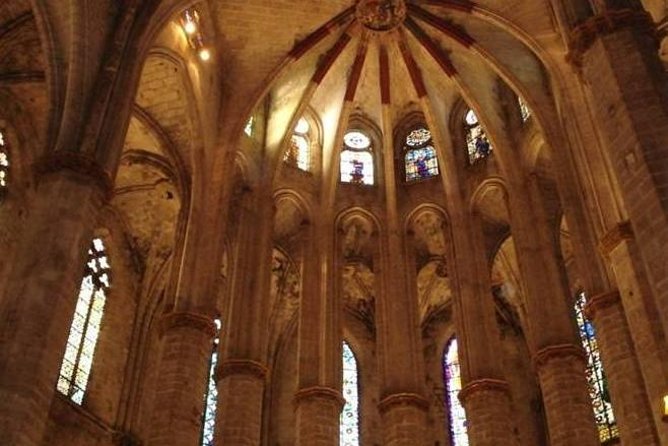
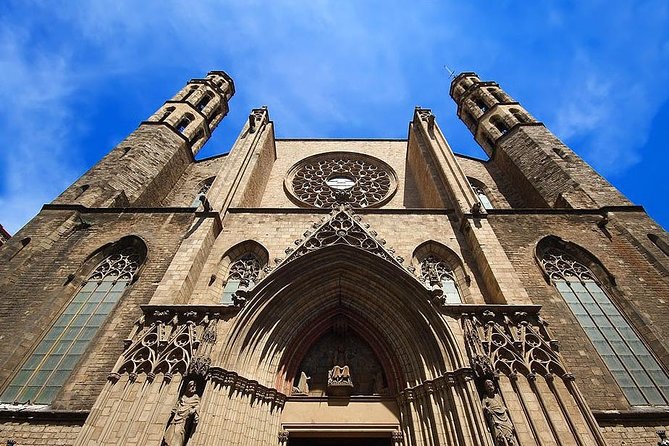
This is the centerpiece. Basilica de Santa Maria del Mar—often called the cathedral of La Ribera—is described as one of the best examples of Gothic style for its harmonious proportions and serenity. That’s exactly the kind of church you want when the novel is asking you to feel faith, community, and tension all at once.
What I like about starting here is that it sets your visual baseline. Once you see the calm, balanced Gothic form of Santa Maria del Mar, the rest of the walk feels like a journey through the book’s world rather than a list of disconnected stops.
A practical note: this stop is listed with free admission. You’re not paying extra to get in, and you can focus your time on listening and looking rather than waiting in a ticket line.
Possible drawback: the route format is described as a guided walk with commentary, not a long church session. If you’re the type who wants long solo time inside, budget a bit of extra time on your own after the tour.
Stop 2: Carrer Montcada and the medieval-to-Baroque “main street” effect
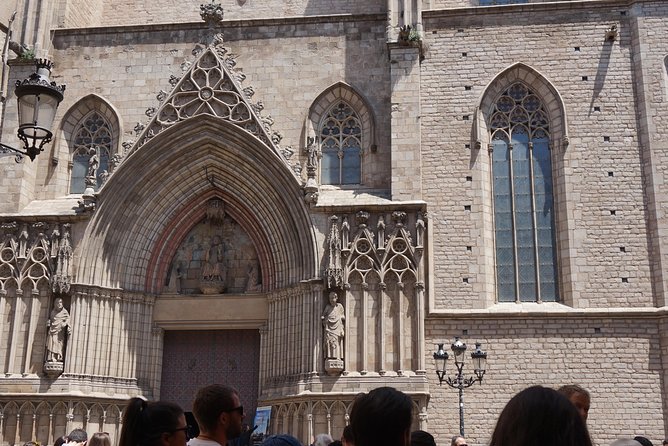
Next comes Carrer Montcada, a street lined with palazzos from multiple eras. The point isn’t just that the buildings look old—it’s that their doorways open onto courtyards and show how Barcelona’s wealth and status changed over time.
This stop is a great “bridge” moment. The book deals with social life and class power, and Carrer Montcada helps you visualize where influence lived. You can stand there and see how architecture works as messaging: who had grand entrances, whose stone spaces stayed protected, and how the street became a stage for the city’s elites.
If you like details, pay attention to the way the street rhythm and building styles shift as you move along. Even without a lecture, your eyes start doing the connecting.
Stop 3: Placa del Rei—one of the clearest windows into medieval Barcelona
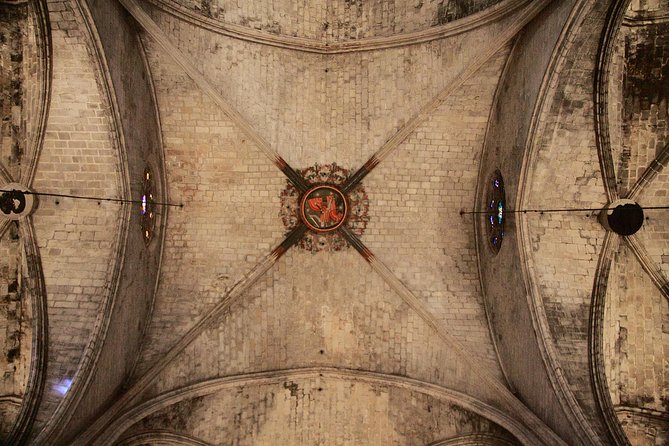
Conjunt Monumental de la Plaça del Rei is often one of the most straightforward ways to picture medieval Barcelona in physical form. This is a Gothic ensemble connected to the city’s earlier political and public life.
This stop is about atmosphere and scale. Squares like this work differently than narrow streets. They’re built for public events, visibility, and power. In the context of The Cathedral of the Sea, that kind of space helps you understand how decisions and crowds would have shaped daily life.
This stop is also listed with free admission, so you’re getting value without extra costs.


Stop 4: Placa de Sant Jaume—civic life still runs through the same “lung”
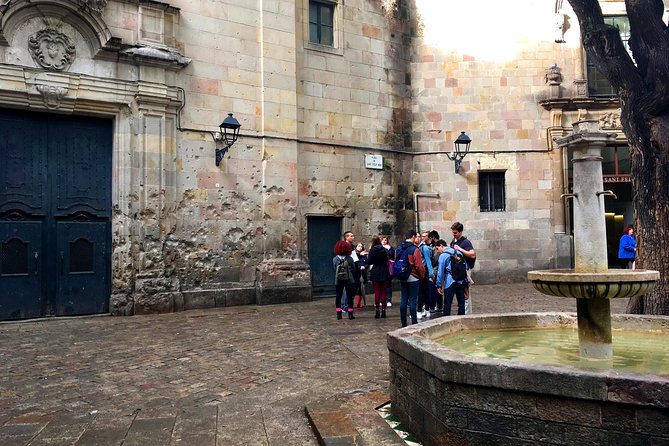
Plaça Sant Jaume is described as the city’s political center for ages, and today it’s an open “lung” in the Gothic Quarter. It’s also where you’ll see key institutional buildings—City Hall and the Palau de la Generalitat.
What I like here is the continuity. You’re not only looking at medieval ruins; you’re seeing how Barcelona’s civic identity stays in the same square framework. That’s a big part of why guided walks can be more satisfying than museum-only days: you’re watching the past and present overlap.
Time check: this stop is kept shorter (about 15 minutes). That’s good if you want the tour to cover more sites. If you’re planning to linger for photos, do that before you move on, not after, since the group will keep moving.
Stop 5: Synagoga Major de Barcelona and the “calls” of the Jewish Quarter
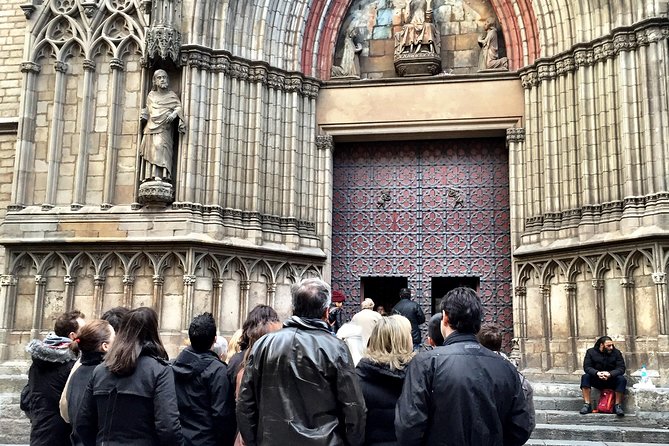
For me, this is one of the tour’s strongest value stops. The tour takes you into the Jewish Quarter and highlights the Synagoga Major de Barcelona, described as one of Europe’s oldest synagogues that’s been restored and opened to the public.
You also get numbers and terminology to help you picture community life: from the 9th to the 14th century, Barcelona had a Jewish community thought to number around 4,000 people. The neighborhood formed around narrow street areas called calls (from the Hebrew word kahal, meaning community or congregation).
This kind of detail matters because it turns “a synagogue stop” into an actual mental map. It helps you understand that the Jewish Quarter wasn’t just a landmark—it was a community space embedded in the city’s street grid.
This stop is listed with free admission. Still, arrive ready to look and listen, because restoration spaces don’t tell their story on their own. The guide’s context makes it click.
Stop 6: Catedral de la Santa Creu i Santa Eulàlia—why going inside changes everything
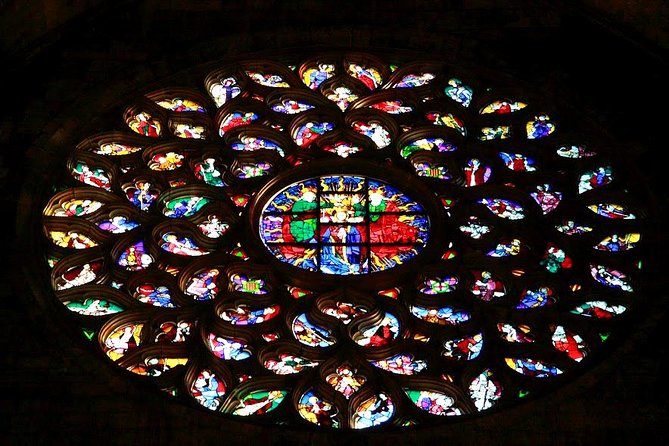
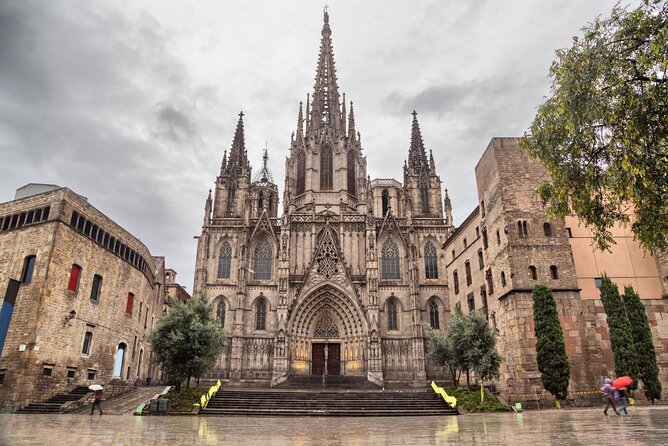
Barcelona’s Catedral de la Santa Creu i Santa Eulàlia gets described as constantly changing, with different generations leaving their imprint. It’s predominantly Gothic, but it reflects a mix of styles, and the tour notes that you really need to view the cathedral inside to grasp its splendor.
This works well at the end of a walk because you’ve already learned how to read the city’s medieval structure. Once you step inside, you can see how time layers buildings and meanings. That’s a better lesson than “look at this because it’s old.”
There’s no separate ticket cost noted here in your tour info, but the tour does flag that you should see it inside rather than only admire from outside.
Price and value: $17.86 for a focused book-and-city loop
At $17.86 per person, this is not a big spend. For the price, you’re paying for:
- a professional guide
- a curated route through key book sites and major Gothic/medieval areas
- a small group format (max 15)
- a tour style that links narrative, architecture, and civic life
You also get practical booking advantages like mobile ticket and mentions of group discounts. And the tour is typically booked around 6 days in advance, which tells me it’s popular enough to plan ahead if you want a specific date.
Is it the cheapest thing in Barcelona? Probably not. But it also isn’t trying to be a full-day museum substitute. It’s a half-day “how the novel maps to the city” experience, and at this price, it’s easier to justify.
Language and group mixing: the one thing to watch
Here’s the main caution I’d put in front of you, based on guide-language feedback you can run into: this kind of walking tour may be run with multiple language groups sharing the same time block. In one case, English speakers felt they got only short English snippets while most commentary landed in Spanish, and it meant they missed key parts of the narrative.
So if English-only storytelling is a top priority for you, I’d check the booking language details carefully before you go. If you’re comfortable following along even when not everything is translated, you’ll likely still enjoy the sights and the route logic.
What to bring (and how to plan your day around the walk)
Since the tour is 2–2.5 hours and in medieval streets, bring:
- comfortable shoes (non-negotiable)
- a light layer for shade or cool morning air
- a small umbrella if the forecast looks wet, since the tour runs in all weather
Try to plan this early in your Barcelona day. The Gothic Quarter and El Born area are easiest when streets are calmer and your brain is fresh. After the tour, you’ll know where to go next—especially for lingering photos or a quick look back at Santa Maria del Mar.
Who should book this tour
This tour fits best if you:
- read or plan to read The Cathedral of the Sea and want the real-world map
- enjoy walking and want context, not just a list of monuments
- want Gothic Quarter highlights plus an important Jewish Quarter stop
It may be less ideal if you:
- need consistently detailed English narration throughout every stop
- prefer long indoor time at major churches over a brisk, multi-site walk
Should you book the Cathedral of the Sea Walking Book Tour?
I’d book it if you like stories tied to place. At $17.86, it’s a smart way to turn a handful of iconic Barcelona sites—Santa Maria del Mar, Placa del Rei, civic squares, and the Synagoga Major—into something you can remember as a connected route.
If you’re picky about language, do a quick check before you reserve. If you can roll with some bilingual conditions, the route still gives you a strong sense of how medieval Barcelona worked, both politically and socially.
And if you’re pairing it with other sights that day, the start and end locations near Plaça de Santa Maria and Plaça Nova make it easy to keep moving.
FAQ
How long is The Cathedral of the Sea walking tour?
It’s about 2 hours on the schedule, with descriptions sometimes running around 2 to 2.5 hours depending on how the group moves.
Where does the tour start and end?
It starts at Plaça de Santa Maria, Ciutat Vella, 08003 Barcelona and ends at Plaça Nova, Ciutat Vella, 08002 Barcelona.
What time does the tour begin?
The start time is 10:00 am.
What is included in the price?
The tour includes a professional guide.
Do I need tickets or will I pay extra at the stops?
Your stop details list admission as free for key locations like Basilica de Santa Maria del Mar, and the other listed stops are presented without paid entry requirements.
Is there a mobile ticket?
Yes, the experience offers a mobile ticket.
What’s the group size?
The tour has a maximum of 15 travelers.
Does the tour run in bad weather?
Yes. It operates in all weather conditions, so dress for walking outside.
Are service animals allowed?
Yes, service animals are allowed.
What’s the cancellation window?
You can cancel for a full refund up to 24 hours before the experience’s start time.