REVIEW · BARCELONA
Barcelona Private Walking Tour: Legends, Myths & Old Streets
Book on Viator →Operated by The Tipsy Tours · Bookable on Viator
Barcelona’s old streets talk back. On this private two-hour walk, you connect legends to real stone—Roman Barcino, the Spanish Inquisition, the Civil War, and Catalan culture—while your guide keeps the pace human-sized and question-friendly.
I love how personal it feels for a group, because you can linger at the places that catch your eye. I also love the range of stops: famous Gothic highlights, plus quieter squares and alleys that most people speed past. The main drawback to consider is that if you’re hoping for lots of time inside major sites (like the synagogue area), this tour is structured around short moments and may feel brief for that specific craving.
In This Review
- Key highlights worth your time
- A private Gothic Quarter walk that keeps its promise in 2 hours
- Meeting at Plaça Nova and setting the mood before you go
- Els 4 Gats, the “World Begins With a Kiss,” and why art belongs in this story
- Barcelona Cathedral area: Roman Barcino, Saint Eulalia, and what’s worth planning
- The quiet squares: Civil War memory at Placa Sant Felip Neri
- El Call (Jewish Quarter) and the MUHBA synagogue area: legends, plague, and a fair warning
- Plaça de Sant Jaume and Plaça del Rei: Catalan government meets royal power
- Plaça de l’Àngel and Santa Eulalia’s procession story
- Basilica de Santa Maria del Mar: finishing in El Born where maritime Barcelona makes sense
- What you’ll notice most: guides like Vanesa, Jordan, Mariya, and Tamara
- Price and value for $178.02 per person on a private 2-hour walk
- Should you book this Barcelona Legends and Old Streets tour?
- FAQ
- How long is the Barcelona private walking tour?
- Where does the tour start and end?
- What time does the tour begin?
- Is this tour private or shared with other groups?
- What major sights are included on the route?
- Are entrance tickets included?
- What kind of ticket will I use?
- Can I cancel for a full refund?
- Who is this tour best suited for?
Key highlights worth your time
- A tight 2-hour route that hits the Gothic Quarter and then finishes in El Born with Santa Maria del Mar
- Story-led stops tied to Roman, medieval, and 19th–20th century Barcelona, not just pretty facades
- Free admission at many photo stops, with a couple of notable exceptions that you’ll plan for
- Guide energy matters, and you’ll hear strong storytelling from guides like Vanesa, George, Jordan, Mariya, Tamara, Sara, and Rolene
- Built for flexibility, so you can ask questions and adjust the pace without a rigid script
A private Gothic Quarter walk that keeps its promise in 2 hours
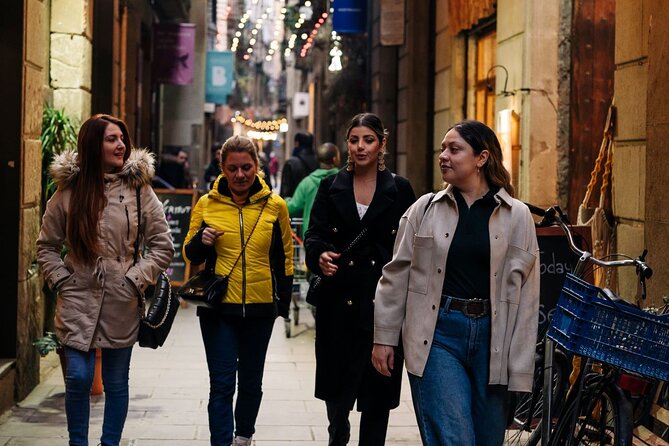
This is the kind of tour that works when you want real context fast. You meet in the center of Ciutat Vella, then spend about two hours walking through the Gothic Quarter and toward El Born. It’s private, so it’s only your group—no mixing in a crowd you didn’t book for.
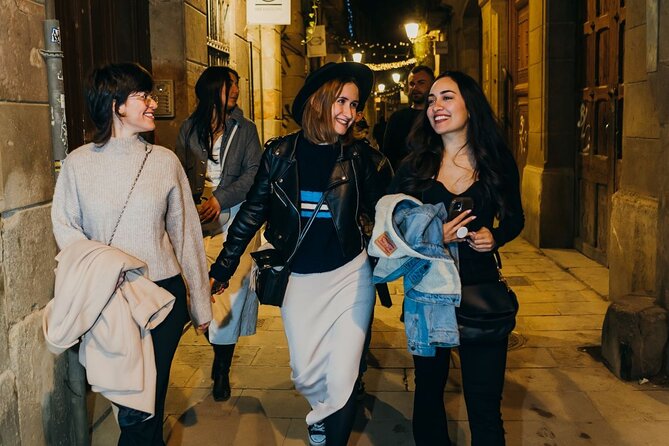
The best part is the tone: you’re not stuck with a lecture. Your guide is there for Q&A, and you can linger when something clicks. People consistently talk about the guides as fun and engaging, with humor and plenty of answers, whether it’s Vanesa, George, Jordan, or Mariya.
One practical note: you’ll move at a city-walking pace through uneven old streets. Wear solid shoes, bring water, and fuel up before you start. It’s short, but it’s still a walk.
You can also read our reviews of more walking tours in Barcelona



Meeting at Plaça Nova and setting the mood before you go
You start at the Barcino Sculpture on Plaça Nova (Ciutat Vella). That’s a good launch point because it places you right in the heart of the old layers—Roman-era references close by, and the Gothic Quarter only a few turns away.
From the start, the tour is designed to help you see connections. You won’t just memorize names; you’ll learn why those places became important. The experience focuses on “how Barcelona got here,” with stories that jump from Roman times to medieval power to modern Catalan identity.
Since the start time is 6:00 pm, you also get a helpful light shift. Evening can make narrow streets feel more dramatic, and it often helps you avoid the worst daytime crush. It’s a simple timing win, especially if you’re trying to keep your sightseeing day from burning out.
Els 4 Gats, the “World Begins With a Kiss,” and why art belongs in this story
The first stop is Els 4 Gats, tucked into the modernist masterpiece of Casa Martí. This isn’t just a pretty exterior moment. It’s famous as a hangout linked with major artists like Pablo Picasso and Antoni Gaudí, which helps you connect Barcelona’s 20th-century creative energy to the city’s older bones.
Next comes El Mon Neix En Cada Besada. It’s described as a photo-mosaic that looks like a kiss on the surface—but it’s also tied to Catalan independence and the fight for freedom. This is a smart choice early in the walk because it trains your eyes: in Barcelona, public art often carries politics and memory, not just romance.
These early stops give you two different entry points: art culture and Catalan identity. That makes the later Gothic and political storytelling land harder, because you’re already thinking about Barcelona as a living argument over time.
Barcelona Cathedral area: Roman Barcino, Saint Eulalia, and what’s worth planning

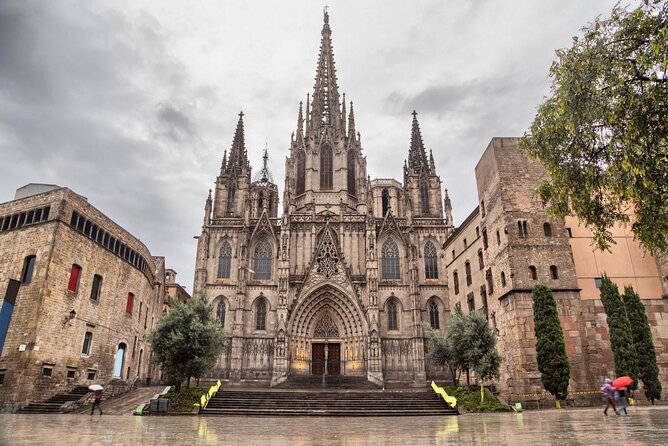
Barcelona Cathedral is the big headline in the Gothic Quarter. The tour frames it with a clear narrative: it’s dedicated to the patron saint of Barcelona, Santa Eulalia, and you’ll hear how the story connects to Rome and her brutal end.
This stop is also one place to plan ahead financially. The cathedral admission is not included, so you’ll want to be ready for that separate ticket if you decide to go in. Even if you don’t, the guide’s framing helps you read what you’re seeing.
Just beside the cathedral, Casa de l’Ardiaca pulls you into tiny-house scale. It’s set up as a time machine to Roman times, with remnants of the Roman wall and aqueducts. This is a good moment when you want more than postcard angles—you’re learning how the ancient city physically pressed up against later Barcelona.
Then there’s Pont del Bisbe, a neo-Gothic bridge built over older layers. It’s short on time, but long on mood. The guide focuses on the legends tied to it, and it’s a great break from “serious” history without losing the thread.
The quiet squares: Civil War memory at Placa Sant Felip Neri
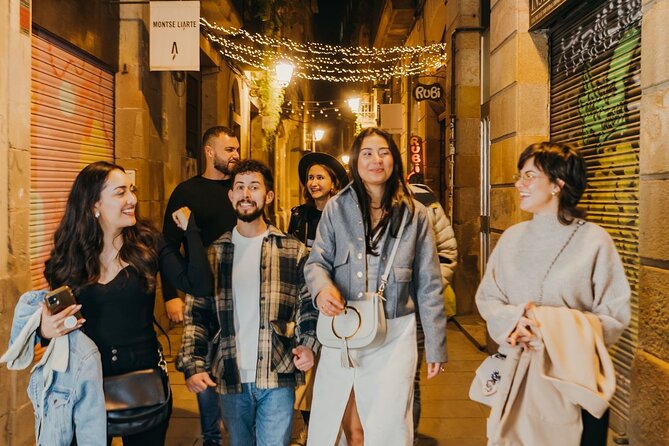
Placa Sant Felip Neri is one of those stops where Barcelona slows down on purpose. It’s hidden in the heart of the Gothic Quarter, and the tour connects it to a sombre story during the Spanish Civil War.
What I like about this kind of stop is that it doesn’t feel like a random “photo break.” You learn why the square matters, and that changes how you look at it. Instead of seeing stone and shadows, you see how public space can preserve fear and grief.
This stop is also free in terms of admission as listed for the tour. You’ll spend around ten minutes here, which is enough for the guide’s story and for you to take in the atmosphere without turning the whole evening into a museum marathon.
You can also read our reviews of more private tours in Barcelona





El Call (Jewish Quarter) and the MUHBA synagogue area: legends, plague, and a fair warning
Next up is MUHBA – El Call, the former Jewish district of Barcelona. The tour is designed to give you a strong sense of what life was like here, including legends and the city’s dark past during the plague. The ancient synagogue is part of what you’ll see in this area.
Here’s the key consideration: this experience is structured around short, guided moments. If your ideal version of the Jewish Quarter visit includes going inside and spending more time on the synagogue experience itself, you may want to pair this with extra time on your own. The tour still covers the big context, but it may not feel like a deep, slow dive for someone who wants that specific level of access.
Even so, the stop is valuable because it gives you the historical spine that helps the rest of the Gothic Quarter make more sense. You start noticing how power, persecution, and survival shape the city’s layout and its stories.
Plaça de Sant Jaume and Plaça del Rei: Catalan government meets royal power
Plaça de Sant Jaume is the main square in the center of the Gothic Quarter, tied to the seat of Catalan government and City Hall. The guide uses this as a turning point: you move from older suffering and survival into public authority.
Then comes Plaça del Rei, where the former royal palace is part of the backdrop. This is where the “legends and myths” theme gets darker. The tour frames the area as a stage for one of the darkest times in Spanish history.
These two squares are also useful for orientation. After you’ve walked alleys and passed walls from different eras, you finally get big-space perspective. You can compare “where power was displayed” against “where stories were hidden,” and it makes the Gothic Quarter feel less like a maze and more like a map with emotion.
Both stops are listed as free admission on the tour schedule, which is helpful if you’re trying to keep costs predictable.
Plaça de l’Àngel and Santa Eulalia’s procession story
Plaça de l’Àngel is a short stop, but it’s a clever one. The tour explains the story behind the procession of Santa Eulalia and the heavenly apparition that led to the change in the square’s name—from a former Wheat Square to what it became later.
I like this stop because it’s easy to miss the meaning behind street names. The guide turns that into a mini lesson in how religion, legend, and everyday life get written into the city’s labels. Ten minutes here can do a lot, especially if you’re trying to understand Barcelona’s mix of sacred story and civic space.
As listed, admission is free for this stop on the tour schedule. So it’s a low-cost way to get a high payoff in context.
Basilica de Santa Maria del Mar: finishing in El Born where maritime Barcelona makes sense
The walk ends at the Basilica de Santa Maria del Mar in El Born, at Plaça de Santa Maria, 1. The tour positions the basilica as a major statement tied to Barcelona’s maritime history.
This is not a quick “pass by it” finish. You get a sense of why the basilica matters and how the sea-linked world shaped the city’s identity. It’s also one of the best places to end if you want your last impression of old Barcelona to feel connected to work, trade, and community.
One planning point: admission for Santa Maria del Mar is not included on the tour schedule. So if you want to go in fully, budget a little extra.
What you’ll notice most: guides like Vanesa, Jordan, Mariya, and Tamara
The tour lives or dies on the guide, and the strong pattern here is storytelling with personality. People mention humor and fast clarity, plus the ability to answer questions without getting stuck in one mode.
You’ll hear names like:
- Vanesa, praised for being wonderful and helpful
- George, noted for engaging, with an effective high-level overview
- Jordan, praised for lots of information delivered in a fun way
- Mariya, described as energetic and entertaining
- Tamara, frequently praised for keeping the group together and sharing useful suggestions
- Sara, remembered for exceeding expectations and providing answers plus restaurant guidance
- Rolene, noted for being easy to follow for foreign visitors
That last detail matters. Barcelona’s street-level history can be confusing if you’re reading signs without context. The best guides turn confusion into direction, so you leave feeling oriented rather than just entertained.
And yes, food advice comes up. Several people mention that their guide’s restaurant recommendations were a real assist after the walk. If you like closing your sightseeing loop with a good dinner, that’s a practical perk.
Price and value for $178.02 per person on a private 2-hour walk
At $178.02 per person, this isn’t a cheap stroll. The value equation is really about what you get beyond the route.
First, you’re booking a private guided experience built around interpretation, not just points on a map. You also get a short duration, which helps you avoid “three hours of walking for two minutes of context.” Ten minutes per stop is enough time to learn the story and get your bearings, without turning the evening into a marathon.
Second, many stops have free admission listed (Els 4 Gats, El Mon Neix En Cada Besada, Casa de l’Ardiaca, Pont del Bisbe, Placa Sant Felip Neri, MUHBA – El Call, Plaça de Sant Jaume, Plaça del Rei, Plaça de l’Àngel). You only need to plan for admissions that aren’t included, like the cathedral and Santa Maria del Mar.
Third, the tour is designed for flexibility. In practice, that means if you care more about one era—Roman layers, Catalan politics, or Civil War memory—you can steer the conversation. That’s hard to replicate with a self-guided audio walk.
If you’re traveling solo, you might feel the cost more. If you’re splitting the experience with a partner or group, it often feels more like what it is: paying for time with a guide who helps you see what you’d otherwise miss.
Should you book this Barcelona Legends and Old Streets tour?
Book it if you want a focused, guided evening in the Gothic Quarter that teaches you how Barcelona’s past keeps resurfacing in street names, squares, and buildings. It’s also a great match for first-timers who feel overwhelmed by the sheer density of Ciutat Vella, and for return visitors who want stories that make the familiar streets feel new again.
Pass on it (or plan extra time) if you need long indoor visits—especially if you’re specifically hoping for a deeper synagogue interior experience. The tour is built around short, high-impact stops, so you’ll get context, but not necessarily extended time inside every major site.
FAQ
How long is the Barcelona private walking tour?
It runs for about two hours.
Where does the tour start and end?
It starts at Barcino Sculpture, Plaça Nova, 40, Ciutat Vella, and ends at Basílica de Santa Maria del Mar, Plaça de Santa Maria, 1 (Ciutat Vella).
What time does the tour begin?
The start time listed is 6:00 pm.
Is this tour private or shared with other groups?
It’s private. Only your group participates.
What major sights are included on the route?
You’ll visit highlights such as Barcelona Cathedral, MUHBA – El Call (Jewish Quarter), Plaça Sant Jaume, Plaça del Rei, and Basilica de Santa Maria del Mar, plus several smaller squares and monuments.
Are entrance tickets included?
Some stops are listed with free admission tickets, while Barcelona Cathedral and Basilica de Santa Maria del Mar are listed as admission not included.
What kind of ticket will I use?
You get a mobile ticket.
Can I cancel for a full refund?
Yes. Free cancellation is available up to 24 hours before the experience starts.
Who is this tour best suited for?
It’s designed for families, couples, and friends who want a deeper, more personal connection to Barcelona, with the option to avoid rigid schedules and crowds.