REVIEW · BARCELONA
Private discovery bike tour of Barcelona
Book on Viator →Operated by Visites Guidées de Barcelone · Bookable on Viator
Three hours, and Barcelona feels manageable. This private discovery bike tour strings together the city’s big visual stories in one ride, from Gothic lanes near Plaça Reial to Gaudí’s Sagrada Família and then out toward the harbor.
I especially like the way the tour keeps your day efficient without turning it into a sprint. You move by bike on mostly low-energy, easy cycling, and the pace leaves room to actually take in what you’re seeing. Another big win is that your guide, Jean-Pierre, can flex the route for your interests, so it’s not a rigid conveyor belt.
One thing to consider: several major stops have admission not included, including the cathedral, Palau de la Música Catalana, La Pedrera, and the Sagrada Família. That doesn’t kill the value, but it does mean you should be ready for a few extra ticket decisions.
In This Review
- Key things you’ll notice on this Barcelona bike tour
- Why a private discovery bike tour is a smart first (or mid-trip) move
- Starting at Plaça Reial: the tour’s perfect “welcome” to Barcelona
- The Gothic Core: Plaça de Sant Jaume and Barcelona Cathedral (and what to watch for)
- Modernisme sprint: Palau de la Música Catalana and the Mansana de la Discordia
- La Pedrera and Sagrada Família: Gaudí’s big statements, with ticket reality
- A break in the story: Arco di Trionfo and the path into Ciutadella
- The seaside finish: Port Olímpic, Platja de Sant Sebastià, and Port Vell
- How the ride feels: pace, bike lanes, and the role of Jean-Pierre
- Tickets and value: what you pay, what you get, what you may still need
- Logistics that matter on the ground: meeting point, timing, and weather
- Who should book this Barcelona bike tour?
- Should you book? My quick decision guide
- FAQ
- How long is the private discovery bike tour of Barcelona?
- Where does the tour start and end?
- Is this a private tour or shared group?
- Is the tour offered in English?
- Are tickets for all the stops included?
- What happens if the weather is bad?
Key things you’ll notice on this Barcelona bike tour
- A private group ride: only your party bikes, so you can ask questions and adjust at the right moments
- Expert-led architecture storytelling with a timeline view from Romans to modern Barcelona
- Modernisme plus Gothic streets, packed into about 12 stops over ~3 hours
- A relaxed, safe-feeling pace that still covers a lot of ground
- Seaside payoff at the end, with beaches and port areas that feel like a natural cool-down
- Mixed ticketing: some sights are free, while key Gaudí and other landmarks may require paid entry
Why a private discovery bike tour is a smart first (or mid-trip) move
Barcelona can feel like two cities at once: the crowd of the center and the maze of neighborhoods just one turn away. This tour helps you get bearings fast because you get a guided sweep across the main layers of the city instead of guessing where to go next.
The private format matters more than it sounds. When you’re not sharing space with strangers, it’s easier for Jean-Pierre to keep your timing comfortable and to respond to questions. It also helps if you want small changes, like spending a bit more time on the beach area rather than sticking strictly to the default flow.
The other practical advantage is time. In about three hours, you cover a serious list of highlights that usually takes a lot longer if you’re relying on trains, taxis, and walking links between far-flung sites.
You can also read our reviews of more cycling tours in Barcelona

Starting at Plaça Reial: the tour’s perfect “welcome” to Barcelona
You begin at Plaça Reial, a square in Ciutat Vella with a famous fountain in the center (the Tres Gràcies) and nearby lamps attributed to Antoni Gaudí. It’s a great opening stop because it visually signals what the tour is really about: Barcelona is part charm, part design, part theatrical history.
You’ll likely get your first orientation here, since Plaça Reial sits in the middle of the old-city energy. That matters because the ride soon threads through areas where it’s easy to feel disoriented on foot.
This first stop is short (about 10 minutes), but it sets the tone. You’re not just starting somewhere convenient; you’re starting somewhere beautiful and recognizable.
The Gothic Core: Plaça de Sant Jaume and Barcelona Cathedral (and what to watch for)
Next you head to Plaça de Sant Jaume, the square where you’ll find the Barcelona city hall and the Catalan government palace. Even if you’re not focused on politics, this stop gives you context for how power and identity show up in everyday streets.
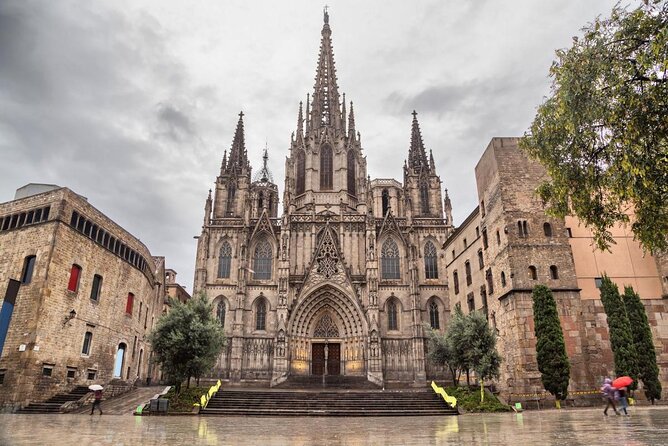
Then comes Catedral de Barcelona, also known as the Catedral de la Santa Creu i Santa Eulàlia. This is where you’ll notice the city’s long architectural timeline. The cathedral is largely Gothic and neo-Gothic, and even the cathedral forecourt includes remnants of Roman wall.
The cathedral stop is about 10 minutes, and admission is not included. That means you’ll still get the exterior and the general setting, but if you want to go inside, you should plan for a paid ticket. If you’re trying to choose what to pay for, this is one of the places where deciding can genuinely change your experience.
Modernisme sprint: Palau de la Música Catalana and the Mansana de la Discordia
After the cathedral area, the tour shifts hard into Modernisme. You’ll stop at Palau de la Música Catalana, the celebrated modernist concert hall designed by Lluís Domènech i Montaner, recognized by UNESCO in 1997. Even without entering, it’s the kind of building where details reward you for slowing down your eyes.
From there, you roll to La Mansana de la Discordia (the Block of Discord). This is one of Barcelona’s most efficient photo stops because you get the idea of “modernist rivalry” in a single stretch: Casa Batlló (Gaudí), Casa Ametller (Josep Puig i Cadafalch), and Casa Lleó i Morera (Domènech i Montaner). The tour gives you about 15 minutes here, which is enough time to pick your favorite façade and read the design logic behind it.
Most importantly, this segment doesn’t feel random. Jean-Pierre’s storytelling connects why these buildings matter, not just that they exist. That’s the difference between seeing architecture and understanding why Barcelona looks the way it does.
La Pedrera and Sagrada Família: Gaudí’s big statements, with ticket reality
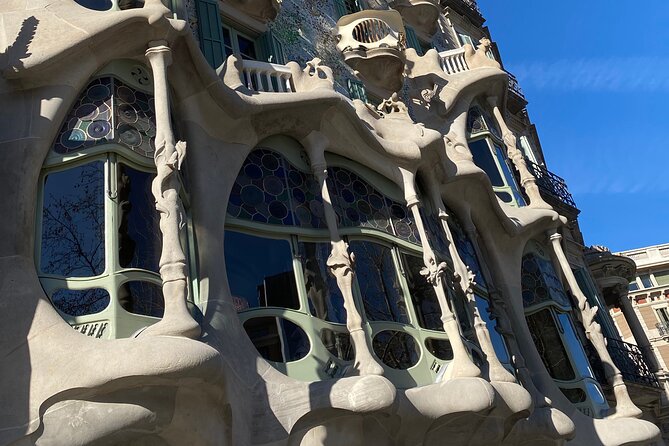
You’ll then reach La Pedrera – Casa Milà on Passeig de Gràcia. This is described as one of Gaudí’s most important and imposing works, and it’s treated as a “last major realization.” It’s also located on one of the city’s most upscale avenues, so the setting alone adds to the vibe.
La Pedrera admission is not included, so you’ll get the guided stop and exterior viewing. If you’re a serious Gaudí fan and want interiors and exhibitions, budget time and money for that separate decision.
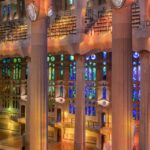
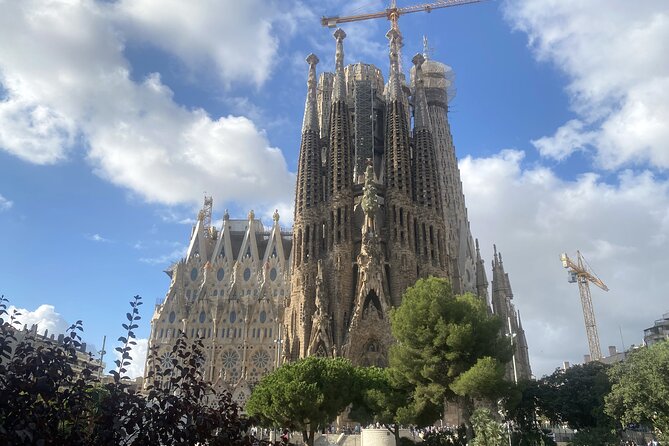
The biggest “must-see” comes next: Basilica de la Sagrada Família. The tour gives it about 20 minutes, and this is framed as Gaudí’s most important work, still under construction. Sagrada Família admission is not included, which is a real consideration because it’s also one of the sites where many visitors most want to go inside.
Here’s how I’d make the decision: if you’re likely to spend more than a quick look at Gaudí’s world, plan for paid entry. If you’re more interested in the overall sweep and already have a later plan for Sagrada Família, this tour still works well because the ride gets you there in a way that feels connected to the rest of the city instead of isolated.
You can also read our reviews of more private tours in Barcelona

A break in the story: Arco di Trionfo and the path into Ciutadella
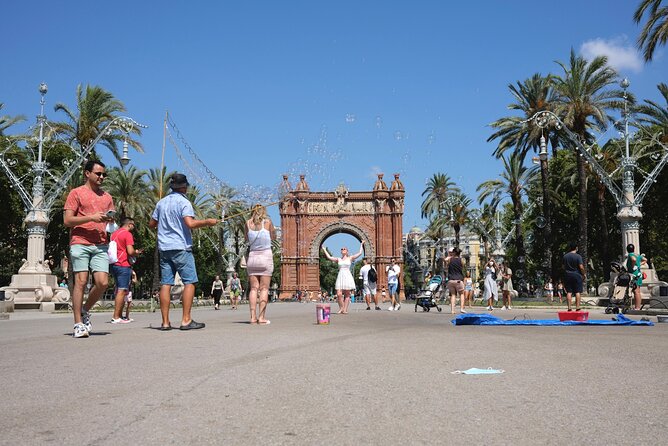
After Gaudí territory, you’ll stop at Arco di Trionfo, described as the entrance portal of Barcelona’s first Universal Exposition held in Parc de la Ciutadella. This is a nice pivot point. You’ve been moving through the city’s identity and ideology; now you’re heading toward a calmer, greener part of the route.
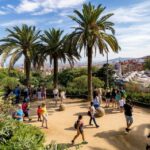
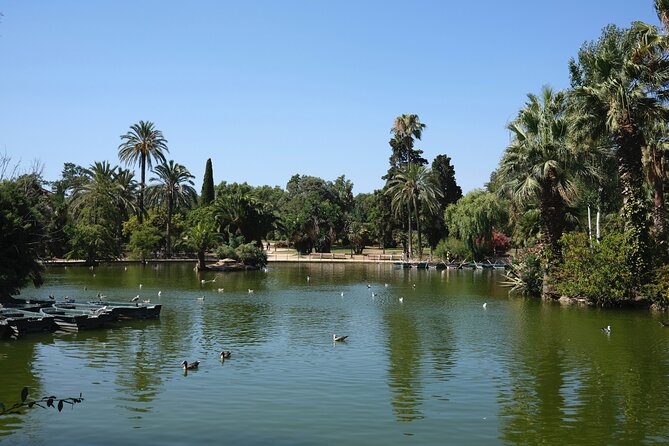
Then you arrive at Parc de la Ciutadella, which used to be an older citadel site and later became the park you can enjoy today. This stop is about 15 minutes, and you might spot a greenhouse, an ombrière, and two science-focused museums: Natural Sciences and Geology. There are also zoo elements and preserved citadel buildings, plus a notable fountain.
Admission is free for this stop per the tour details. Even if you don’t step into museums, it’s a valuable change of pace from crowds and façades.
The seaside finish: Port Olímpic, Platja de Sant Sebastià, and Port Vell
Barcelona’s end-of-ride payoff is the water. You’ll head to Port Olímpic (about 10 minutes), then ride along the waterfront at Platja de Sant Sebastià in the Barceloneta area (about 10 minutes). The tour also includes Port Vell (Old Port) with another short promenade.
All of these are listed with free admission, which is great because you get that “we’re done, but still enjoying” feeling without more ticket decisions.
This seaside segment also helps your brain consolidate the day. You’ve just looked at towers, stonework, and dense urban design. The harbor and beach give you a visual reset, and it helps the ride feel like a complete loop instead of an out-and-back tour.
How the ride feels: pace, bike lanes, and the role of Jean-Pierre
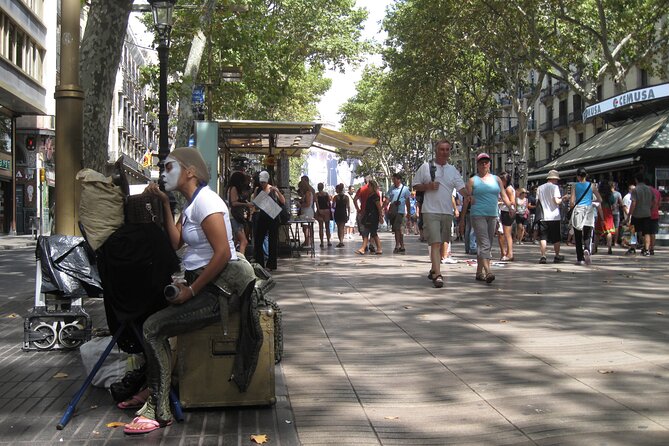
What makes this tour enjoyable isn’t just the sights. It’s the way they’re connected by a route that feels manageable on a bike.
In practice, you get flat-city style riding with dedicated bike lanes, which is a huge deal in a city where pedestrian streets can get crowded. Multiple people highlighted that biking felt low-energy and doable for people who don’t normally bike in cities, and that matches what you want from a three-hour introduction tour.
Jean-Pierre comes through again and again in the tone of the experience: friendly, careful about safety, and willing to explain what you’re looking at at each stop. He also uses maps that cover the city from Roman times to today, which helps you see Barcelona as one story rather than a list of attractions.
There are two practical “listen up” notes to keep in mind. First, if you’re sensitive to audio, you might find a soft-spoken explanation a bit harder to catch in street noise. Second, for families, bike weight can be a factor, and the guide has adjusted for kids when needed. If you know you’ll struggle with heavier bikes or loud environments, tell the guide early so they can position you better.
Tickets and value: what you pay, what you get, what you may still need
The price is $48.37 per person for about three hours. That’s not a huge amount for a route that touches major Barcelona landmarks, plus the guide time and biking logistics.
Here’s where the value math gets real. Several stops are free (Plaça Reial, Plaça de Sant Jaume, La Mansana de la Discordia, Arco di Trionfo, Parc de la Ciutadella, Port Olímpic, Platja de Sant Sebastià, Port Vell). But key stops have paid admission not included (the cathedral, Palau de la Música Catalana, La Pedrera, and Sagrada Família).
So you’re getting a guided “greatest hits” ride where you can choose which paid interiors you want to prioritize. If you’re the kind of traveler who likes to visit everything, you’ll likely pay for several of those. If you’re the kind of traveler who prefers a visual overview plus time for one or two deeper entries later, this tour still gives you a strong foundation.
One more value point: it’s a private tour, meaning it’s for your group only. That usually changes the feel of the ride from crowded attraction-watching into a calmer, more personal city walk—just faster.
Logistics that matter on the ground: meeting point, timing, and weather
The meeting point is Plaça Reial in Ciutat Vella, and the tour ends back at the same place. That’s helpful because you’re not stuck searching for your pickup spot after you’re tired and happy.
It’s offered in English, and you’ll receive a mobile ticket. Confirmation happens at booking unless you’re booking within a day of travel, in which case confirmation comes as soon as possible based on availability.
One practical caution: the experience requires good weather. If it can’t run due to weather conditions, you’ll be offered a different date or a full refund. For a bike tour, this rule is exactly what you want to see.
Finally, most travelers can participate, and the start area is near public transportation. That makes it easier to plug into a normal Barcelona day plan.
Who should book this Barcelona bike tour?
This tour is a strong fit if you want:
- a first-time Barcelona overview with major sites connected in a smart route
- architecture and design storytelling, especially Modernisme and Gaudí’s presence
- an experience that stays low-stress thanks to biking and bike-lane options
- flexibility for small detours, like leaning toward the beach finish
It’s also a nice choice if you have limited time and want to come away with a clear sense of how neighborhoods link together. A lot of value comes from seeing the city as a route, not as isolated stops.
If you’re only looking for one or two museums and you’re set on long, ticket-heavy visits, you might find the “some admissions not included” structure a bit limiting. In that case, you’d pair this with separate timed entries on the days you want deeper inside-the-building time.
Should you book? My quick decision guide
Book it if you want a guided ride that helps you get your bearings fast, with a mix of Gothic streets, Modernisme façades, and harbor views. The price is fair for what you cover, and the private format makes it feel more like a local guided route than a tour-group production.
Skip or rethink if paid entry is your top priority and you’re hoping everything is included in the ticket. This tour is still excellent for exterior viewing and context, but you will likely pay separately for some marquee interiors.
If you’re planning ahead, this one tends to be booked around 43 days in advance, so I’d lock it in early to get the time slot you want.
FAQ
How long is the private discovery bike tour of Barcelona?
It’s about 3 hours.
Where does the tour start and end?
The tour starts at Plaça Reial and ends back at the same meeting point.
Is this a private tour or shared group?
It’s private, so only your group participates.
Is the tour offered in English?
Yes, it is offered in English.
Are tickets for all the stops included?
No. Admission is not included for the Cathedral of Barcelona, Palau de la Música Catalana, La Pedrera (Casa Milà), and the Sagrada Família. Other listed stops on the route are marked free.
What happens if the weather is bad?
The experience requires good weather. If it’s canceled due to poor weather, you’ll be offered a different date or a full refund.