REVIEW · BARCELONA
Gaudí and Barcelona Legends Walking Tour
Book on Viator →Operated by The Barcelona Feeling · Bookable on Viator
Gaudí is everywhere, but this makes it readable. In a compact 2 hours, you get context for the façades on Passeig de Gràcia and beyond, with stops like Casa Milà (La Pedrera) and Casa Batlló. I also love how guides such as Christian and Michael keep the pace moving while still making you notice details you’d normally miss.
My only heads-up: the tour covers the exteriors and stops, but entrance tickets are not included, so if you want to go inside multiple buildings, budget extra time and money. Also, it’s a walking tour with a moderate fitness level requirement, so comfortable shoes matter.
In This Review
- Key highlights to know before you go
- How a 2-hour Gaudí walk turns the city into a lesson
- Small group size that actually feels small
- Meeting point on Passeig de Gràcia: start where the story begins
- Casa Milà (La Pedrera): the façade stop that sets up the rest
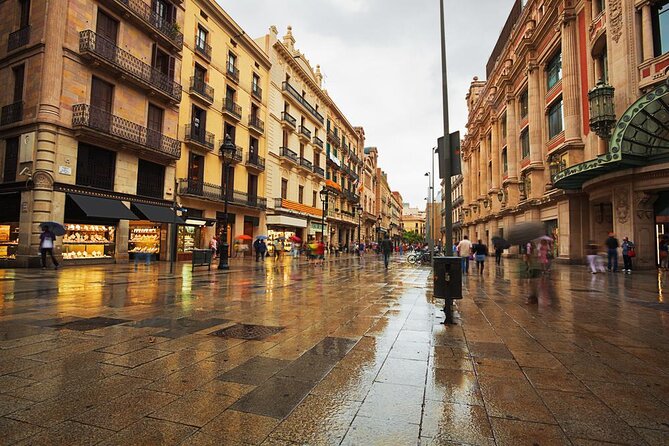
- Passeig de Gràcia: reading the street from pavement to lamps
- Casa Batlló: Gaudí’s creativity, explained on the outside
- Casa Amatller: the stop people often miss (and you shouldn’t)
- La Mansana de la Discordia: learning to compare façades fast
- Plaça Catalunya as a breather between eras
- Els 4 Gats: art café history with real names attached
- Palau de la Música Catalana: Modernisme details you can spot outside
- El Born: legends, neighborhood walking, and your payoff
- Price and what you’re truly paying for
- English guide and a practical pace that works for couples and families
- Who should book this tour
- Quick practical tips before you go
- Should you book the Gaudí and Barcelona Legends Walking Tour?
- FAQ
- How long is the Gaudí and Barcelona Legends Walking Tour?
- How much does the tour cost?
- Is the tour offered in English?
- Are entrance tickets to attractions included?
- Where do we meet, and where does the tour end?
- How big is the group?
- Can I cancel for a full refund, and are service animals allowed?
Key highlights to know before you go
- Passeig de Gràcia façade focus: you’ll learn what you’re looking at, not just where to stand for a photo
- Casa Milà to Casa Batlló flow: quick, organized stops that help you connect Gaudí’s ideas
- Modernisme contrasts: Casa Amatller and Casa Morera (part of the Mansana de la Discordia) show the style clash in one area
- Els 4 Gats + Picasso/Gaudí link: a cultural detour that makes Barcelona feel like a real story
- El Born legends: a neighborhood walk that ties the myths and history together
- Small-group feel: limited to eight for a personalized experience, with the operator listing a max of 15
How a 2-hour Gaudí walk turns the city into a lesson
Barcelona can feel like a blur when you’re sightseeing. This tour is built to slow you down in the right way: you walk key corridors and learn the meaning behind what you see, especially on the Modernisme stretch around Passeig de Gràcia. You’re not stuck in a museum line for hours, and you still come away with names, timing, and architectural clues that help the rest of your trip click.
What I like most is that it’s not just Gaudí-worship from start to finish. You also get the broader Modernist world—how different architects and visions showed up on the same streets—so Barcelona stops feeling like a single artist’s playground and starts feeling like a whole era with competing ideas.
And because it ends at Palau de la Música Catalana, you finish in a part of the city that’s easy to keep exploring on foot.
You can also read our reviews of more walking tours in Barcelona



Small group size that actually feels small
This isn’t a huge crowd tour. The experience is described as limited to eight for a personalized feel, while the operator lists a maximum of 15 travelers. Either way, it’s designed for interaction, not for shouting over 40 people.
That matters because the guide’s best tool is conversation: questions, quick prompts, and tying each façade detail to a bigger theme. In practical terms, you get more “wait, look at that” moments and less “everyone stand here for the photo” time.
If you like architecture but hate long lectures, this size can be a sweet spot—short enough to stay lively, big enough that you’re not doing everything in near-silence.
Meeting point on Passeig de Gràcia: start where the story begins
You’ll meet at Pg. de Gràcia, 90 (L’Eixample). That’s a good choice because it puts you right on the main stage of Barcelona’s Modernisme boom. From there, the walk naturally strings together buildings that make comparisons easy—especially for Gaudí vs. his contemporaries.
You also end at Palau de la Música Catalana in Ciutat Vella (C/ Palau de la Música, 4-6). It’s a convenient landing point because you don’t end up back where you started. You finish closer to older Barcelona streets, including the route into El Born.
Casa Milà (La Pedrera): the façade stop that sets up the rest
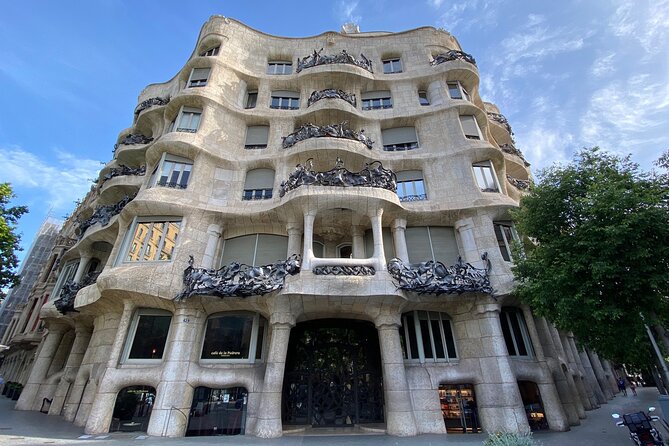
Stop one is Casa Milà – La Pedrera. The tour focuses on the building’s history and façade, and it gives you one key idea that helps everything that follows: it was Gaudí’s last civic building before he dedicated the rest of his life to Sagrada Família.
Even if you’ve seen photos of La Pedrera before, this kind of framing changes how you look. You start paying attention to why Gaudí would be thinking about public presence and then shifting gears into a lifelong religious project. You’re basically getting a timeline break at the first stop, which makes the rest of the walk feel more connected.
Practical note: the stop is about 10 minutes, and admission isn’t included. That’s ideal for learning what to spot from the street, but it also means you won’t be going inside unless you choose to add that later.
Passeig de Gràcia: reading the street from pavement to lamps
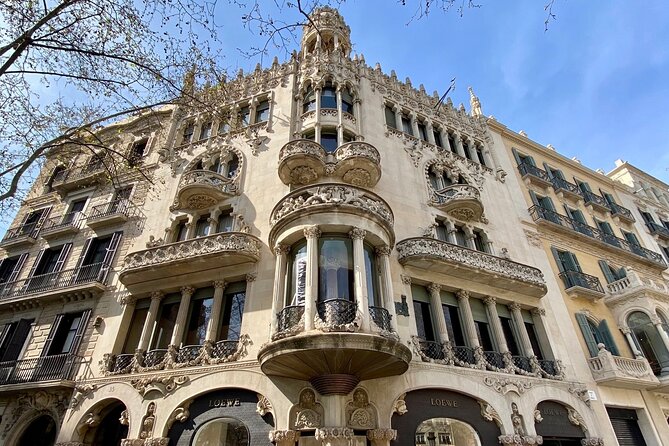
Between major buildings, you’ll walk down Passeig de Gràcia, and the tour’s pitch is clever: the guide wants you to see stories “from street pavement to lamp posts.” That sounds small, but it’s a real sightseeing advantage.
When a guide points out street-level elements, you start noticing the design logic of the whole corridor, not just the famous façades. It also helps you keep moving without feeling rushed through the “not famous yet” stretch.
This segment is a good mental warm-up. By the time you reach the next house, you’ll already know how to look: not only for curves and ornament, but for the reasoning behind them.



Casa Batlló: Gaudí’s creativity, explained on the outside
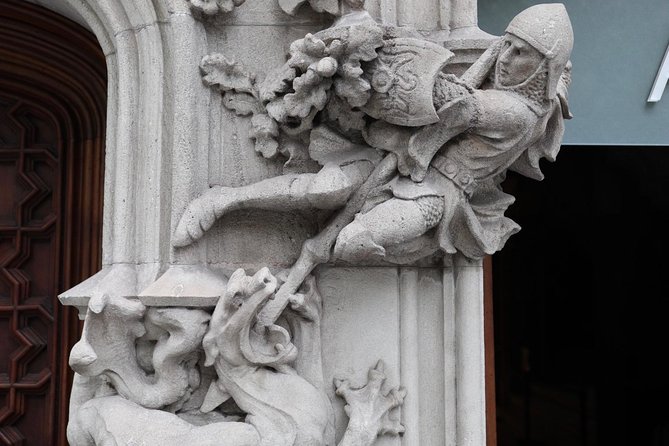
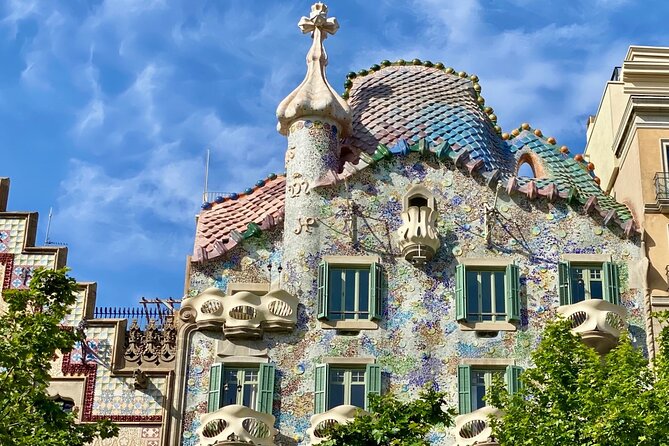
Next up is Casa Batlló, another headline name on the Passeig de Gràcia lineup. Here, the focus stays consistent: you learn about the exterior façade and Gaudí’s ingenuity in how the building was designed.
Stop length is about 10 minutes, and—again—admission isn’t included. So you’re not trying to cram a full interior visit into your schedule. Instead, you get a guided “what matters on the outside” pass, which is great if you want to keep the overall pace.
If you tend to feel underwhelmed by architecture tours that only point and name, this stop format is more satisfying. It’s not just, Gaudí made this. It’s: here’s what you should pay attention to when you look at it.
Casa Amatller: the stop people often miss (and you shouldn’t)
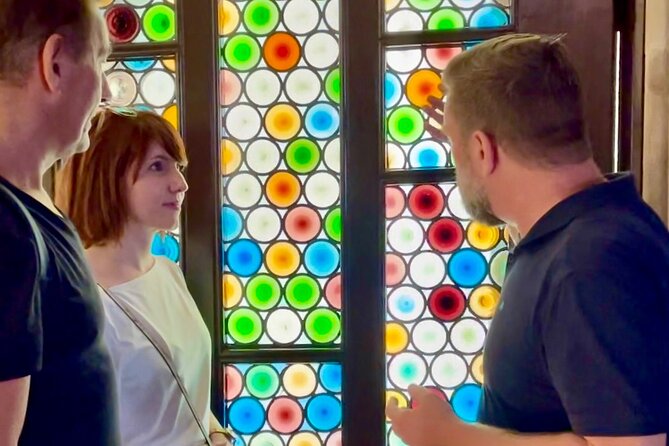
Then comes Casa Amatller, one of Barcelona’s Modernist buildings that many people skip over. The tour’s angle is that it’s fascinating, but it doesn’t always get the same attention as the big two.
Your time here is about 10 minutes, and admission isn’t included. The guide focuses on the building’s history and architecture. That combination is valuable because it helps you connect style choices with cultural intent, not just decorative impact.
What I like about including Amatller in the route is that it prevents the tour from becoming a checklist. You come away with at least three different “how did they think?” perspectives, not only two.
La Mansana de la Discordia: learning to compare façades fast
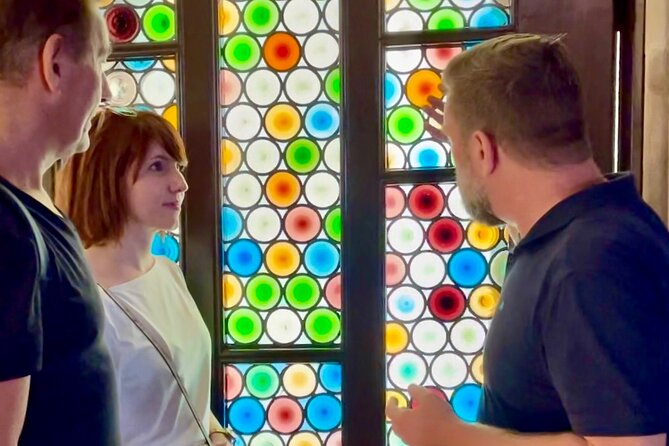
A key stop in the walk is La Mansana de la Discordia—the block where different Modernist visions appear side-by-side. You’ll see Casa Morera and you’ll get one specific theme: the building has stunning craftsmanship, lots of floral decoration, and the guide will point out a surprising detail hidden behind all that ornament.
Casa Morera is also credited to Lluís Domènech i Montaner, which is an important name if you want to understand Barcelona’s Modernisme beyond Gaudí. Even if you don’t memorize every artist name, you can feel the difference between the design languages.
This stop is shorter—about 5 minutes—so it’s not a deep interior-style explanation. Instead, it’s designed for comparison. You’ll be learning to spot contrast quickly, which is exactly what you want when you’re walking and time is limited.
Plaça Catalunya as a breather between eras
You’ll pass Plaça Catalunya, described as the connector between the new town (Eixample) and the old town. It’s more than a landmark here—it’s a mental reset.
This kind of transition is useful because it helps your brain stop treating Barcelona as one blob of buildings. You can feel the shift from the Modernisme emphasis of the Eixample grid into the older streets that lead toward El Born.
Els 4 Gats: art café history with real names attached
One of the most fun parts of the route is Els 4 Gats. The tour frames it as a modernist art café that mattered to Barcelona in a similar way to how Parisian cafés mattered in that era. It also ties the place to famous creators—Picasso and Gaudí came here.
Here, the goal isn’t a strict architecture lecture. It’s cultural context. You stop at a place that helped ideas spread, not just buildings stand. That makes the city feel lived-in and not only designed.
This stop is about 10 minutes, and there’s no admission fee for the visit itself.
If you love the human side of city history—people meeting, plotting, sketching—this is the kind of detour that keeps the tour from feeling too formal.
Palau de la Música Catalana: Modernisme details you can spot outside
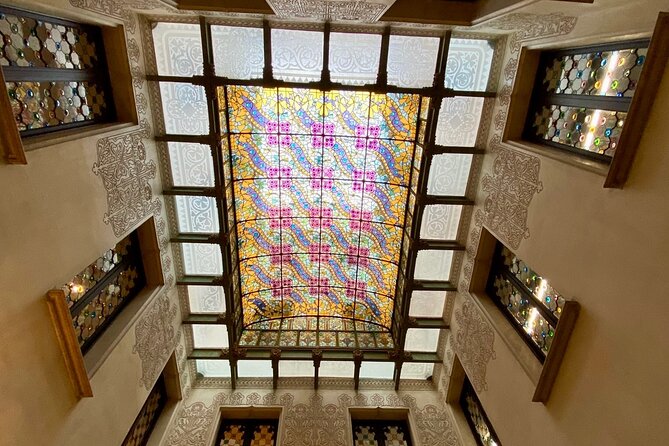
Next, you’ll head to the Palace of Catalan Music (Palau de la Música Catalana). This stop focuses on the outer façade with its many details, and you’ll also get a glimpse into the lobby area.
Time is about 10 minutes, and admission isn’t included as part of the tour. That said, the viewing angle matters. You’re going for the visual rhythm of the façade and the dramatic feel of the interior space at the edge of your view—not a full ticketed visit.
Why this works: it ends the architecture-heavy segment with a building that feels theatrical even when you’re just looking from the street. It also sets you up well for continuing your day in the area after the tour finishes.
El Born: legends, neighborhood walking, and your payoff
The final act is El Born, where you spend about 30 minutes exploring the neighborhood and picking up references to the legends you heard earlier on the tour.
This is where the walking tour format pays off. In the first half, you’re building your visual and historical toolkit. In the last half, you use it to read the streets around you. You start noticing how old Barcelona stories and architecture connect, even when you’re not inside any building.
There’s no admission fee for this part, and it’s a longer block than most of the stops—so you get time to slow down, take photos, and just wander with purpose.
Price and what you’re truly paying for
The tour costs $46.85 per person and runs around 2 hours. For that price, you’re paying for a guided route, a structured explanation of several major façades, and a small-group experience.
The catch is clear: entrance fees to attractions are not included. The stops at Casa Milà and Casa Batlló are both about seeing and learning from the outside, and the tour explicitly doesn’t include tickets. That can actually be good value if you want guidance without paying for multiple building admissions.
If you know you want to go inside several sites later, you’ll want to treat this as the orientation layer. Think of it as the tour that helps you decide which interiors are worth your time and money.
English guide and a practical pace that works for couples and families
The tour is offered in English, and it’s paced to fit a tight 2-hour window. That makes it a strong choice if you’re traveling with teens or anyone who has a limited attention span for pure museum time.
The guide style also sounds designed for participation—asking questions and keeping people involved—so you’re not just passively listening while walking in a line.
Group size matters here too. A smaller group helps the guide tailor explanations on the fly, especially when people ask where to look next.
Who should book this tour
I’d book this if:
- You want a high-efficiency overview of Gaudí and Modernisme around Passeig de Gràcia
- You like architecture, but you also want the city’s human story (Els 4 Gats) woven in
- You’d rather learn what you see from the street than commit to several ticketed interiors
I might skip it if:
- You want mostly indoor visits and long time at each site
- You’re hoping every stop includes admission
Quick practical tips before you go
- Wear comfortable shoes. The route is a walking tour, and you’ll be on your feet for about 2 hours.
- Bring a mobile-friendly form for your mobile ticket, since it’s part of the experience.
- If you care about interiors, plan your own ticket add-ons afterward; the tour focuses on guided viewing and context.
- Plan to book ahead. This is commonly booked about 66 days in advance on average, which usually means you should grab a spot early.
Should you book the Gaudí and Barcelona Legends Walking Tour?
Yes, if you want Barcelona to make sense fast. For the money, you get a guided, small-group walk that connects Gaudí’s story to the broader Modernist world, with cultural stops and a finish in El Born that turns legends into something you can actually see around you.
Just go in with the right expectation: it’s a smart exterior-and-street context tour, not a multiple-building ticket bundle. If you’re okay adding indoor tickets separately, you’ll likely feel like the guide did the heavy lifting so you can enjoy the rest of the day on your own.
FAQ
How long is the Gaudí and Barcelona Legends Walking Tour?
It lasts about 2 hours.
How much does the tour cost?
The price is $46.85 per person.
Is the tour offered in English?
Yes, it is offered in English.
Are entrance tickets to attractions included?
No. Entrance fees to any attraction are not included.
Where do we meet, and where does the tour end?
You start at Pg. de Gràcia, 90, L’Eixample, 08008 Barcelona, Spain, and end at Palau de la Música Catalana, C/ Palau de la Música, 4-6, Ciutat Vella, 08003 Barcelona, Spain.
How big is the group?
It’s limited to eight for a personalized experience, and the operator lists a maximum of 15 travelers.
Can I cancel for a full refund, and are service animals allowed?
You can cancel for a full refund if you cancel at least 24 hours before the experience starts. Service animals are allowed.