REVIEW · BARCELONA
Raval Street Art and Graffiti Guided Tour in Barcelona
Book on Viator →Operated by Street Art Barcelona · Bookable on Viator
Barcelona’s street art feels personal. This Raval guided walk turns ordinary walls into art with context, plus a stop at the Tres Chemineas skate spot that locals treat like a landmark.
What I really like is the small-group setup (max 15), which keeps the pace human and the photos actually useful. You also get explanations from your guide about the artists and the social ideas behind what you’re seeing.
One thing to keep in mind: the tour focuses on street art and neighborhood atmosphere, so if you want museum-style explanations or big-ticket monuments, you may feel a bit outside your comfort zone.
In This Review
- Key highlights to look forward to
- Raval Street Art in Two Hours: Why This Walk Feels Local
- Start at Jardins Talía (Not the Finish): Logistics That Matter
- The First Moves: Finding the Old, Popular Center in Modern Raval
- Tres Chemineas: The Skate Spot Stop That Changes the Whole Mood
- How the Guide Turns Walls Into Stories (And Why That’s the Value)
- Beyond the Main Stops: Optional Detours and Community Access
- Photos, Pace, and the Walk You’ll Actually Enjoy
- Price and Value: What $32.58 Gets You in Barcelona
- Who Should Book This (and Who Might Want a Different Fit)
- Should You Book the Raval Street Art and Graffiti Tour?
- FAQ
- How long is the Raval Street Art and Graffiti guided tour?
- What does it cost?
- What’s the group size?
- Is the tour offered in English?
- Where does the tour start and end?
- What’s included in the price?
- What’s not included?
- Is there a mobile ticket?
- Can I cancel for a full refund?
- Are service animals allowed?
Key highlights to look forward to
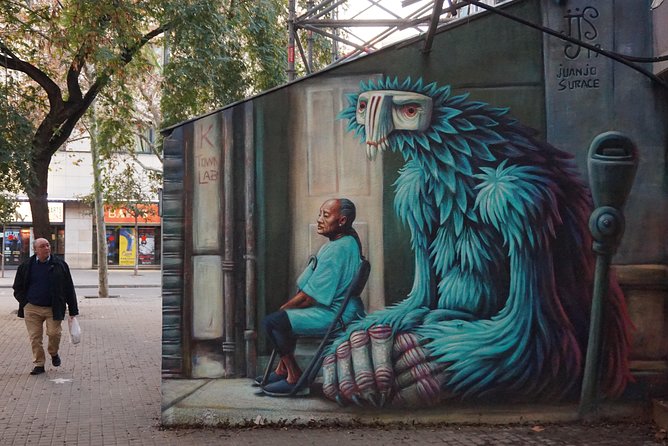
- Small group (max 15): easier questions, less crowd pressure, better attention.
- Street-art focus, not just photos: you’ll learn what techniques and messages to notice.
- Tres Chemineas skate stop: a local hangout that adds real “place” to the art.
- Guides with real street credibility: names like Juan and Olga have been praised for solid art community insight.
- Easy city-center ending: you finish near Museu d’Art Contemporani de Barcelona, ready to keep exploring.
Raval Street Art in Two Hours: Why This Walk Feels Local
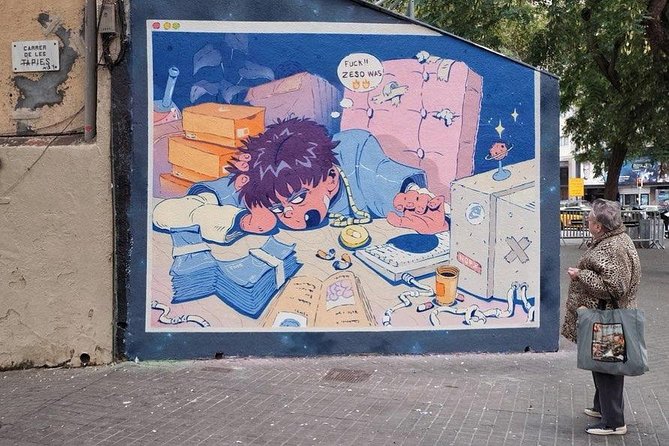
Raval can look chaotic from a distance, but on this tour it starts to make sense fast. You move at a comfortable walking pace while your guide helps you read the neighborhood the way locals do—through the tags, stencils, paste-ups, shutters, and the tiny details most people miss.
Two things make it work. First, it’s built for focus: about 2 hours, not an all-day commitment. Second, you’re not only chasing pretty art—you’re learning how graffiti and street art function as public voice, not just decoration.
This is also a walk that fits well early in your trip. If you do it at the start, the city walls keep teaching you as you move around afterward.
You can also read our reviews of more guided tours in Barcelona



Start at Jardins Talía (Not the Finish): Logistics That Matter
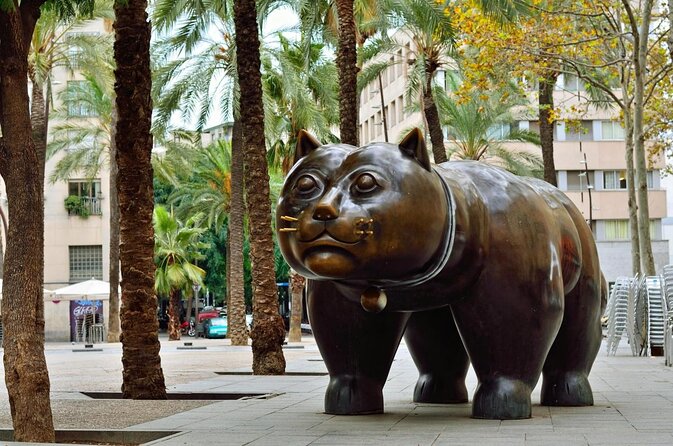
The tour begins at Jardins Talía, Sant Antoni (Eixample), 08015 Barcelona, and ends at Museu d’Art Contemporani de Barcelona, Plaça dels Àngels 1, Ciutat Vella, 08001 Barcelona. That means you’re not doing a circle tour—you’re walking a route through central Barcelona and handing you off to a convenient museum area at the end.
Here’s the practical tip I’d give you: double-check that you’re at the beginning meeting spot, not the ending one. A few visitors got the pins mixed up in the app, and it caused a stressful scramble because the two locations are about 15–20 minutes apart by subway.
If you’re trying to keep this smooth, show up with a little buffer. One review specifically mentioned a meeting point being tricky to find—yet the guide waited and helped sort it out, so arriving early is your best move.
The First Moves: Finding the Old, Popular Center in Modern Raval
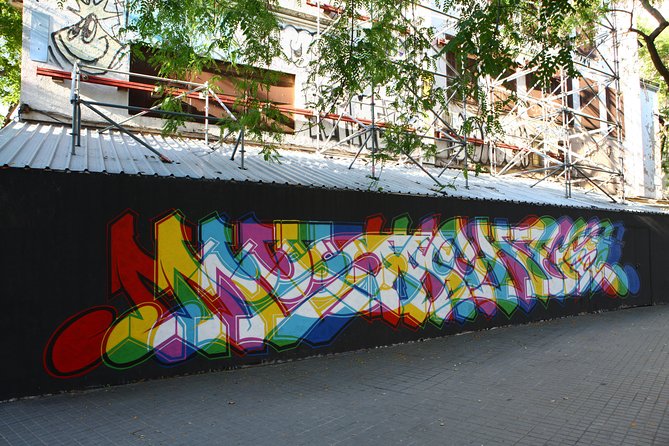
The early part of the tour is about settling into the “antic popular neighbourhood” feeling of the city center. You start with the kind of context that makes the next walls click: what Raval looked like, what it became, and why street art fits here so naturally.
This is where the guide’s storytelling matters. Different guides bring different strengths, and you can see that in the names praised by other visitors. People have highlighted Olga for her deep ties to the Barcelona art community, and Jeanne for passion and clear organization through the streets.
I like that the tour doesn’t treat street art as isolated artwork. Instead, it frames it as something tied to the people living around it—so you’re walking through a neighborhood lens, not a scavenger hunt.
Tres Chemineas: The Skate Spot Stop That Changes the Whole Mood
The tour’s most “this is Barcelona” moment is the time spent at Tres Chemineas, described as a legendary skate spot. This isn’t just a photo stop. It’s the kind of place where street culture isn’t forced into a tourist script—you see how the neighborhood actually gathers.
Why that matters for your understanding: street art and graffiti often live next to other subcultures—skateboarding, music, youth scenes, and informal community spaces. When you add that setting, the art stops feeling random and starts feeling like part of a scene.
You’ll also notice your brain working differently. After seeing art in the right place, you start looking at the city as a message board. People have come away saying they could spot more details afterward—small shutters, paste-ups above street signs, and the kind of layered work that changes over time.
How the Guide Turns Walls Into Stories (And Why That’s the Value)
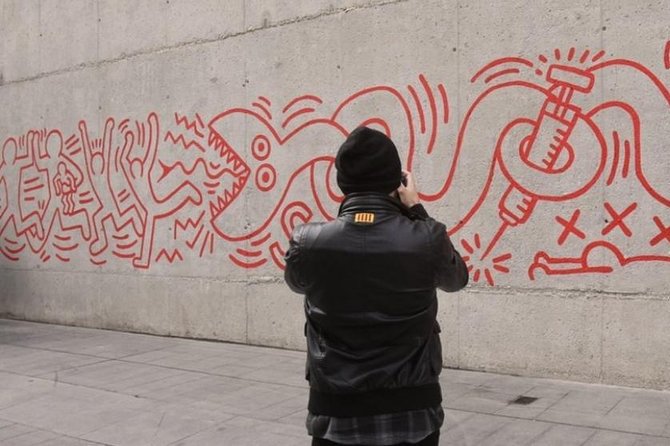
The included core of this tour is the local guide, and that’s the heart of the price. At $32.58 per person, you’re not paying for a long itinerary—you’re paying for interpretation.
Your guide is there to help you answer the questions you’ll naturally have while walking:
- Who made this, and what were they responding to?
- Why this spot, this style, this placement?
- What does the neighborhood context add?
Some guides bring extra street-art credibility. One review noted that Juan is a street artist himself, which likely helps explain techniques and the mindset behind the work. Others called out guides like Olga and Anaïs for making the walk organized while still covering history, art style, and social commentary.
I’ll be honest: if you’re the type who walks past street art, shrugs, and keeps going, you’ll still enjoy the visuals. But if you like learning what you’re looking at, this is where the tour starts paying you back.
You can also read our reviews of more tours and experiences in Barcelona






Beyond the Main Stops: Optional Detours and Community Access
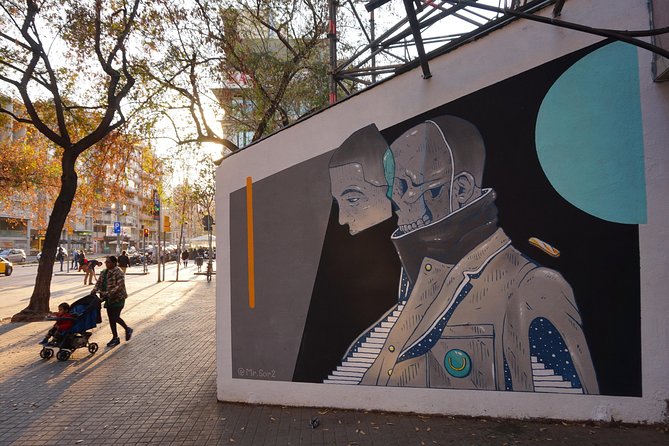
The official flow includes discovering the central neighborhood and hanging around at Tres Chemineas, but guides may add context as you go. In reviews, visitors mentioned a detour to learn about an old church in the area—described as predating the Gothic churches and still in use.
Another story that came up: access to a community garden area tied to local activism, with mention of a person named Flora who started the garden and has lived there for decades. That kind of access may not be guaranteed every time, and it depends on keys and local cooperation, but it’s a good example of how a guide can connect street art to real community life.
Think of these moments like bonus layers. The tour gives you the framework; the guide adds the human connections when they can.
Photos, Pace, and the Walk You’ll Actually Enjoy
A lot of people come to Barcelona for architecture, food, and museums. A street art tour can be the perfect counterweight if it’s paced well and explained clearly—and several reviews mention that the experience is easy and photo-friendly.
Because the group is small (max 15), the pace stays adjustable. One visitor described being just two people on the tour, which made the experience feel more personal and allowed extra time on details. That matters in a place like Raval, where the best stuff is often not at eye level or not the first thing you notice.
Expect a walking tour feel, not a sit-down lecture. If you’d rather move and look, you’re in the right format.
Price and Value: What $32.58 Gets You in Barcelona
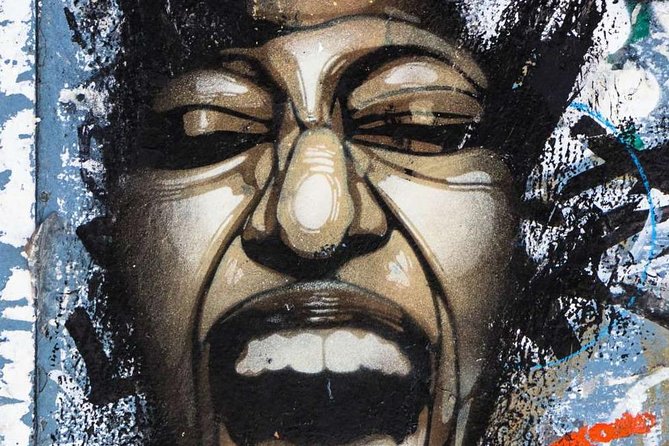
Let’s talk value in plain terms. $32.58 for about 2 hours isn’t cheap like a self-guided walk, but it also isn’t trying to replace major attractions. It’s paying for something you can’t easily buy as a download: interpretation plus a real route.
You’re also getting:
- an English-speaking guide,
- a local perspective on art in hidden corners,
- and an ending location near a major museum area, so you’re not stranded far from your next plan.
If you like street art already, this becomes a shortcut to understanding. If you don’t care about graffiti much, you’ll still get something useful: a sharper eye for how cities communicate in public space.
Just don’t expect museum audio-guide depth. This is street-level learning: context, style cues, and why the work belongs in the neighborhood.
Who Should Book This (and Who Might Want a Different Fit)
This tour fits best if you:
- want an off-the-beaten-path look at Barcelona,
- enjoy street art beyond basic photos,
- like neighborhood storytelling with art and social context,
- and you’re comfortable walking through city streets.
It might be less ideal if you’re only interested in famous monuments or indoor, ticketed sights. Raval’s charm here is the art + atmosphere, not a grand architectural set-piece.
Also, you’ll likely appreciate this more if you’re early in your trip. Several comments suggest doing it early helps you see Barcelona differently for the rest of your days.
Should You Book the Raval Street Art and Graffiti Tour?
Yes, I’d book it if you want to understand Barcelona at street level. The biggest strength is that it’s guided well for the price: small group, real storytelling, and a stop at Tres Chemineas that turns the art into a scene.
I’d also plan smarter around the meeting point. Arrive a bit early, confirm you’re at Jardins Talía (start), and don’t assume the app pin means the right spot. That’s the one logistical snag that popped up, and it’s an easy fix.
Finally, have the right mindset: you’re not collecting landmark photos. You’re training your eyes—so when you leave, the city starts talking back.
FAQ
How long is the Raval Street Art and Graffiti guided tour?
The tour lasts about 2 hours.
What does it cost?
It costs $32.58 per person.
What’s the group size?
The tour has a maximum of 15 travelers.
Is the tour offered in English?
Yes, it’s offered in English.
Where does the tour start and end?
It starts at Jardins Talía, Sant Antoni (08015 Barcelona) and ends at Museu d’Art Contemporani de Barcelona, Plaça dels Àngels 1 (08001 Barcelona).
What’s included in the price?
You get a local guide and the experience of discovering artistic talent in hidden corners of Raval, with details about Barcelona’s art scene.
What’s not included?
Hotel pick-up and drop-off and extra food and drinks are not included.
Is there a mobile ticket?
Yes, the tour uses a mobile ticket.
Can I cancel for a full refund?
You can cancel up to 24 hours in advance for a full refund. If you cancel less than 24 hours before the start time, you won’t receive a refund.
Are service animals allowed?
Yes, service animals are allowed.