REVIEW · BARCELONA
Barcelona in One Day: Gaudí, Gothic Quarter &Tapas (Private Tour)
Book on Viator →Operated by Icono Spain Tours · Bookable on Viator
Barcelona fits in five hours, if you plan. This private tour strings Roman roots, Gothic streets, and Gaudí buildings into one practical route, with timing built to dodge peak crowds and a Sagrada Família visit later in the day.
What I like most is that you get major sights plus a few quieter medieval stops, without turning the day into a stress-fest. You’ll also enjoy the fact it’s just your party, so the pace can shift to how your group is doing.
My second big win: the mix is balanced—Gothic and Jewish Barcelona in the morning, then Modernisme on Passeig de Gràcia, and finally Gaudí’s masterpiece when the atmosphere changes. One drawback to weigh: you’ll cover a lot on foot in about 5 hours, and some interiors (like the cathedral and Gaudí houses) require separate tickets.
In This Review
- Key things to know before you go
- A five-hour Barcelona plan that actually holds together
- Plaça Nova to Plaça del Rei: Gothic Quarter with Roman roots
- Plaça Sant Jaume and the Sinagoga Major: political Barcelona and Jewish call streets
- La Rambla and Boqueria: where the city crowds turn into theater
- Gaudí on Passeig de Gràcia: Casa Batlló and La Pedrera
- Sagrada Família at 4 pm: the ending that changes the whole day
- Guides, pacing, and the real feel of a private group day
- Price and value: what $264.34 covers, and what you may add
- Who this tour is best for (and who should skip it)
- Should you book this Barcelona in One Day tour?
- FAQ
- How long is the Barcelona in One Day tour?
- Is this tour private?
- What language is the tour offered in?
- Where does the tour start and end?
- Is Sagrada Família admission included?
- Are tickets included for the cathedral and Gaudí houses?
- What time is the Sagrada Família visit?
- Does the tour include breaks for restrooms and refreshments?
- Is the tour designed to avoid crowds?
- What is the cancellation policy?
Key things to know before you go
- Private time with your group only, so you’re not sharing the route with strangers
- Crowd-smart Sagrada Família timing, starting around 4 pm for a calmer interior visit
- Gothic Quarter stops that most people skip, including Casa de l’Ardiaca and Plaça del Rei
- Tapas and market energy, with La Rambla and the Boqueria Market built into the day
- Three major Gaudí sights, but not all interiors are included—plan for extra admissions
A five-hour Barcelona plan that actually holds together
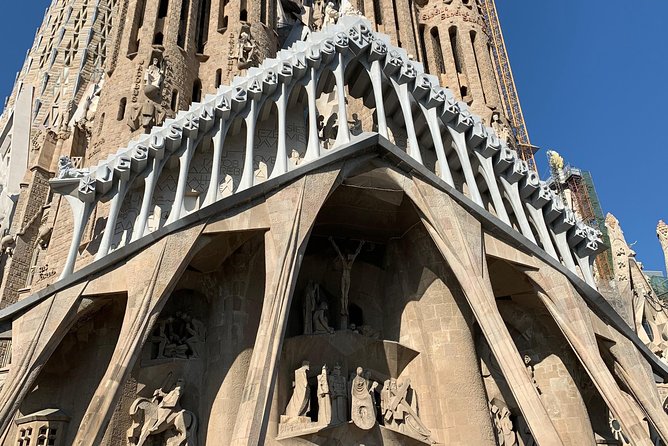
This is the kind of day that works when you’re time-limited and still want variety. You start in the Gothic Quarter area, then flow through medieval Barcelona, slide down La Rambla to the Boqueria, and finish on the Gaudí track—Casa Batlló, La Pedrera, and Sagrada Família.
The best part is the sequencing. The Gothic Quarter portion gives you history and atmosphere first, then you shift to Modernisme, and you end with Sagrada Família in the evening window where visitor traffic tends to ease. That means less time waiting and more time looking—exactly what you want when you only have one day.
Also, the day is paced with restrooms and refreshments breaks included. And yes, it is a walking tour: one review clocked about 12,000 steps in roughly 5 hours. If you like to roam slowly on your own, this may feel fast; if you like a structured highlights day with a guide, it’s a good match.
You can also read our reviews of more private tours in Barcelona



Plaça Nova to Plaça del Rei: Gothic Quarter with Roman roots
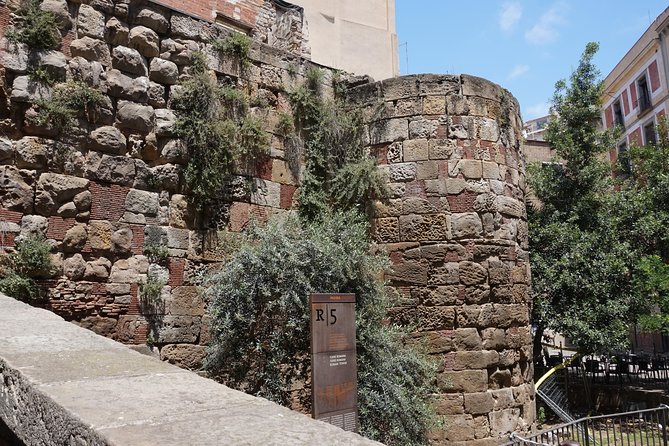
Your morning begins at Plaça Nova in the Gothic Quarter, close to the wall of the old Roman city. Right there, seven oversized letters spell Barcino—part of an alphabet created by Joan Brossa. The detail that makes it fun: some letters are bronze and one is aluminum, bolted to the ground like a visual poem.
That matters because it sets the tone for the rest of the day. You’re not just seeing buildings; you’re spotting how Barcelona has layered identity over centuries—Roman foundations under medieval streets under modern art touches.
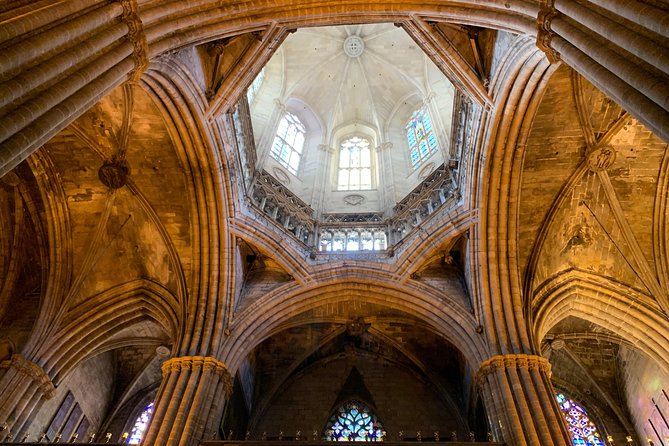
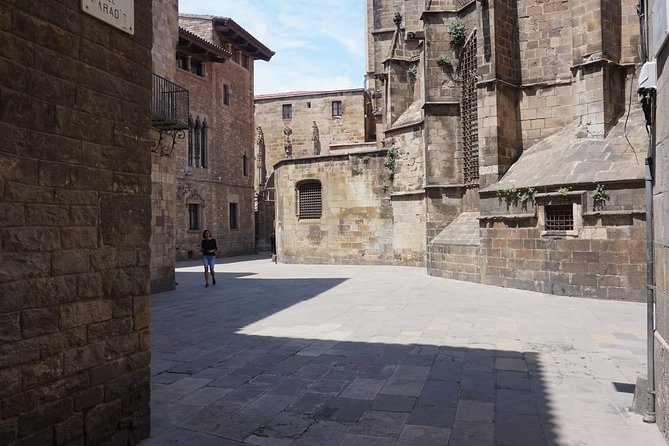
Next comes the Cathedral de Barcelona stop. The interior is the focus: Gothic architecture, an impressive nave, chapels, and a cloister that feels calmer than the streets outside. You’re on-site for about 10 minutes, so you’ll get a taste rather than a full sit-down visit. One practical note: admission isn’t included, so if you care about seeing inside rather than just the exterior, have your ticket ready.
From there, you’ll visit Casa de l’Ardiaca. This is one of those places that rewards a quick stop with the right context. It served as the residence of the ecclesiastical hierarchy starting in the 12th century, then saw major alterations in the 16th century. The changes connected it to the dean’s residence and added the porticoed central courtyard plus Renaissance-style decoration that blends with the original flamboyant Gothic feel. There’s also a staircase to an upper terrace with a balcony style often described as Romeo and Juliet-like.
Then you’ll step into the peaceful medieval focus of Plaça del Rei, a monumental Gothic ensemble. This is one of the best moments for atmosphere: the royal palace complex (Palau Reial Major) and surrounding buildings enclose a square that still feels like it’s holding onto the Middle Ages. It’s free to enter and worth using the short visit to just absorb the shape of the place.
Plaça Sant Jaume and the Sinagoga Major: political Barcelona and Jewish call streets
Plaça Sant Jaume is the next key stop. If you want to understand Barcelona beyond monuments, this square is it. It’s been the city’s political center for centuries, and today it’s anchored by major civic buildings: City Hall and the Palau de la Generalitat.
You don’t spend long here—about 10 minutes—but the payoff is big. It’s a simple open space with a clear role in the city’s story. Even if you don’t memorize dates, you’ll leave with a better mental map of how power and place connect in Barcelona.
After that, the tour shifts to the Jewish Quarter with the Sinagoga Major de Barcelona. This is Europe’s oldest synagogues category in scale and significance. The site has been restored and opened to the public, and it connects to the medieval Jewish community that grew from the 9th to the 14th centuries, thought to be around 4,000 people at the peak.
The concept of the calls (kahal), or community/congregation neighborhoods, is the key idea I like here. It helps you understand why the streets feel the way they do—narrow, human-scale, built around community life rather than grand avenues.
This stop is short (about 5 minutes) and free, so treat it like a quick orientation moment. If you want more time inside, you may need an additional visit later.
La Rambla and Boqueria: where the city crowds turn into theater
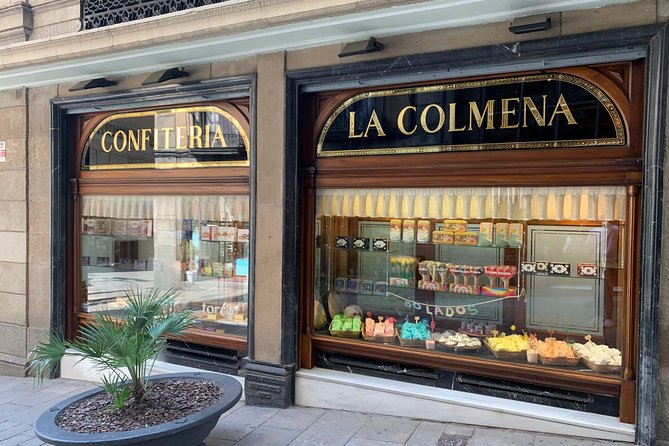
Now you hit La Rambla, a 1.2-kilometer stretch that almost everyone walks at some point. It was laid out in 1766 and follows contours of medieval walls that bounded the area since the 13th century. Locals embraced it quickly because it became the only broad leisure space in a city full of tight, winding streets.
What I like about this segment is that it’s not framed as a single landmark. You move through a living pedestrian corridor where different social classes historically mixed. You’ll feel the street energy without needing to force it.
Then comes Mercat de la Boqueria. The market is described as the evolution from older peddler life into a modern, colorful market scene. The real value is watching how people move—like a human river—especially if you enjoy market culture more than museum culture.
The stop lasts about 30 minutes. That’s enough time to snack, look closely at displays, and still continue the day without feeling stuck. It’s also one of the better places to buy a small edible souvenir for the train ride or the walk back to your apartment later.
Gaudí on Passeig de Gràcia: Casa Batlló and La Pedrera
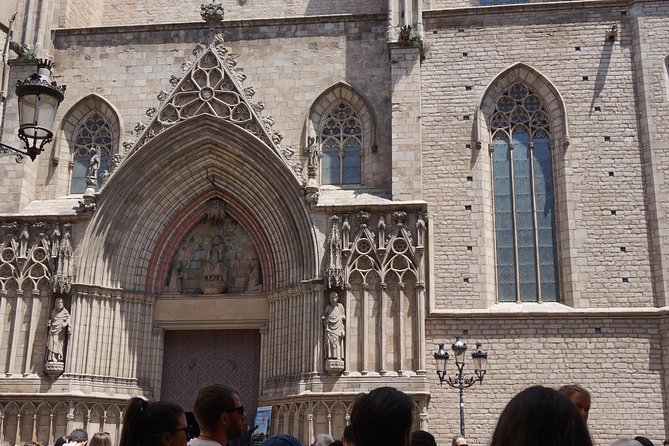
After La Rambla and the market, you’ll shift to Gaudí’s world in the Eixample district on Passeig de Gràcia. This is where the day turns from medieval texture to Modernisme drama.
First is Casa Batlló, about 10 minutes on this stop. It’s one of Gaudí’s masterpieces, remodeled in 1904 from an older house. The building’s local name, Casa dels ossos (House of Bones), points to how organic and skeletal the structure feels.
The façade is the big moment: irregular oval windows, flowing sculpted stone work, almost no straight lines, and the signature mosaic made from broken ceramics called trencadís. Even the roof is part of the story—it’s often likened to the back of a dragon or dinosaur, and there’s a theory that a lance of Saint George is represented by a rounded feature ending at a turret and cross.
A practical note: admission isn’t included for Casa Batlló. If you want to see the inside, you should budget for it and be prepared for the fact that interiors take time. This tour is built to move, so think of Casa Batlló here as your visual highlight and orientation.
Next comes La Pedrera, also called Casa Milà. You’ll spend about 15 minutes outside/at the site. This was Gaudí’s last private residence design, built between 1906 and 1912. At the time, it was controversial for the undulating stone façade and the twisting wrought-iron balconies. But it’s also where you see clever structural ideas: a self-supporting stone façade, a free-plan floor, an underground garage, and a standout roof terrace.
La Pedrera became a UNESCO World Heritage Site in 1984. Since 2013 it’s been used for the Fundació Catalunya La Pedrera programming. Again, admission isn’t included on this stop, so if you want the full interior and terrace experience, you’ll likely need extra time beyond what this one-day route allows.
You can also read our reviews of more tours and experiences in Barcelona





Sagrada Família at 4 pm: the ending that changes the whole day
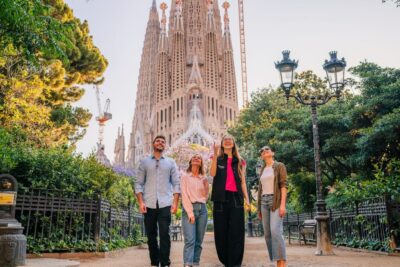
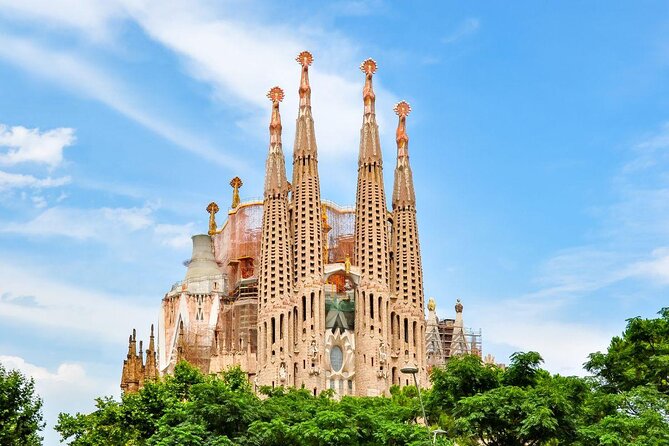
This is the capstone. Your Sagrada Família visit lasts about 1 hour, and the tour’s timing focuses on the evening schedule starting around 4 pm, when the flow of visitors usually decreases. That’s a smart choice, because it shifts Sagrada Família from a line-and-stare experience into something calmer where you can actually look.
Your ticket is included here, which is a big value point. Also, the tour is designed to end back near the meeting point, so you’re not left scrambling for transport afterward.
What you should expect from this portion is not rushing through the highlights. It’s a quieter window for interior details and for just walking slowly in the space. If you’re the kind of person who likes to pause, tilt your head, and take in design features piece by piece, Sagrada Família is the moment where the day pays off.
Guides, pacing, and the real feel of a private group day
Even though the day is structured, it’s still private, meaning it’s only your party. That matters in Barcelona because different groups move differently. Some people want photo time at every stop; others prefer a quick look and then snacks.
In the feedback I saw, guides such as Olga, Carla, Valentina, Anna, Pol, and Viggo were praised for making the time feel personal—like seeing the city with a friend who can explain what you’re looking at. I wouldn’t rely on a specific name, but it tells you what kind of guide quality the company tends to deliver.
The pacing is designed to avoid peak crowds, and it includes breaks. Still, because this is packed with sites, you should be ready for walking days. If your group is sensitive to long walks, the first Gothic Quarter portion moves from stop to stop without hanging around too long.
Price and value: what $264.34 covers, and what you may add
At $264.34 per person, this isn’t a budget tour—but it’s not priced like a luxury car-and-driver day either. The value math mostly comes from two things:
- You get a private guide for the full 5-hour window, plus a tightly timed route that ends with Sagrada Família in the late-afternoon slot.
- Sagrada Família admission is included, while other major interiors are marked as not included.
So for real cost planning, think about extra tickets for places like the cathedral interior, Casa Batlló, and La Pedrera if you want to go inside those. If you’re happy with quick exterior-focused looks for those Gaudí stops and you mainly want a full Sagrada interior experience, this pricing likely feels more reasonable.
Also, this experience centers on Gaudí and the Gothic Quarter with tapas built into the overall day. In past accounts of the day, the food portion landed well—one highlight was tapas paired with wine—so you’re not just touring stone and leaving hungry.
Who this tour is best for (and who should skip it)
This tour fits best if you:
- have one day and want the big Barcelona highlights plus more medieval texture
- care about Gaudí, but also want the Gothic Quarter story that explains the city’s older layer
- like a private guide and a route that’s designed around crowd timing
- don’t mind walking and want breaks for restrooms and refreshments
You might skip it if you want a slow, no-pressure day with lots of free time in each neighborhood. The schedule is meant to hit a lot of points. The upside is that it’s efficient; the trade-off is that you won’t linger for hours at each stop without adjusting the plan.
Should you book this Barcelona in One Day tour?
I’d book it if your goal is simple: see the core Barcelona landmarks, get context fast, eat well, and finish with Sagrada Família at a smarter time. The private setup and the evening Sagrada schedule are strong reasons to choose this format over piecing together a DIY route—especially if you hate standing in lines.
I’d think twice if you hate a brisk pace or you know your group will want long interior visits at every Gaudí site. If you want that kind of slow, choose a route that gives more time per building, or be ready to spend extra on admissions and plan your expectations.
FAQ
How long is the Barcelona in One Day tour?
It runs for about 5 hours.
Is this tour private?
Yes. It’s private, and only your group participates.
What language is the tour offered in?
It’s offered in English.
Where does the tour start and end?
It starts at Av. de la Catedral, 7, Ciutat Vella, 08002 Barcelona, Spain, and ends back at the meeting point.
Is Sagrada Família admission included?
Yes. The Sagrada Família visit includes the admission ticket.
Are tickets included for the cathedral and Gaudí houses?
No. The cathedral, Casa Batlló, and La Pedrera list admission as not included.
What time is the Sagrada Família visit?
The plan focuses on the evening, starting at around 4 pm.
Does the tour include breaks for restrooms and refreshments?
Yes. Breaks for restrooms and refreshments are included.
Is the tour designed to avoid crowds?
Yes. The itinerary is carefully timed to help avoid peak crowds, and it ends with Sagrada Família when visitor flow is lower.
What is the cancellation policy?
You can cancel for a full refund up to 24 hours in advance. The tour also depends on good weather, and if it’s canceled due to poor weather, you’ll be offered a different date or a full refund.