Barcelona’s old streets feel alive fast.
I love the small-group size—it stays personal and you’re not just a number. I also like how Luca stitches together 2,000 years of Barcelona so the stones make sense, not just scenery. The route is on foot and designed for easy wandering, so you finish feeling oriented and curious.
One thing to plan for: this is mostly an outdoor walk. On hot, sunny days you can feel it, and Luca may choose a sun-facing side in spots—bring water and be ready to slow down if needed.
In This Review
- Key points worth knowing before you go
- Why This 2¼-Hour Old Town Walk Works So Well
- Getting Oriented at Plaça de Sant Jaume (Barcelona’s Power Core)
- MUHBA Temple d’August: The Roman Backbone You Can Actually See
- Catedral de Barcelona: Gothic Outside Views (No Ticket Stress)
- The Gothic Quarter’s Standout Feature (And Why It Matters)
- MUHBA El Call + Església de Sant Felip Neri: A Small Route With Big Emotional Range
- El Born / La Ribera: Medieval Streets That Still Set the Mood
- Santa Maria del Mar: The Church People Actually Care About
- El Fossar de les Moreres + Passeig del Born: Politics and Play on One Route
- Luca’s Tour Style: Energy, Humor, and a Photo Binder Worth the Price
- Price and Logistics: Great Value, Easy Start, Clear Ending
- Who Should Book This (And Who Might Skip It)
- A Simple Bring-This Checklist for a Summer Walk
- Should You Book Luca’s Hidden Old Barcelona: Gothic and El Born?
- FAQ
- How long is Luca’s Hidden Old Barcelona: the Gothic and El Born Tour?
- Where does the tour start and end?
- Is the tour offered in English?
- How big is the group?
- Do I need to pay for admission at the stops?
- Is the tour suitable for reduced mobility?
Key points worth knowing before you go
- Personal pace, max 15 people: lots of time for questions without losing the flow
- Two eras at once: Roman traces, medieval streets, church corners, and Catalan politics
- MUHBA stops are free: you get museum-grade context without extra fees on many sights
- Outside sights still count: you’ll get the cathedral without paying for entry just to stand there
- Luca adds local bite: humor and sharp context that make the past feel less dusty
Why This 2¼-Hour Old Town Walk Works So Well
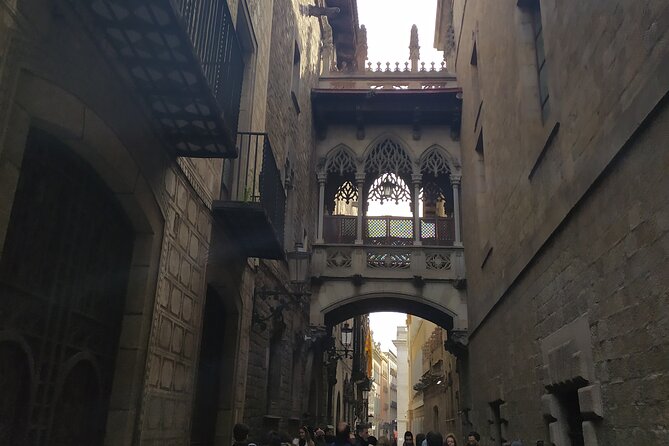
This is the kind of tour I like on the first day (or any day when you want your bearings fast). In about 2 hours 15 minutes, you cover a tight loop through the Gothic Quarter and El Born / La Ribera, with enough stops to feel you learned something real—without feeling like you spent your whole afternoon in a headset.
The small-group limit (15 people) matters more than you might think. You can hear Luca clearly, ask questions when something clicks, and you’re more likely to remember the details because the tour feels like a conversation. And at $13.27 per person, it’s priced like a value play: a professional guide plus a focused route through places you’d otherwise only skim.
The route also stays practical: it’s walking-based, near public transport, and it ends in the Born area (handy if you want to keep exploring right away). If you’re bringing a friend who loves photos, Luca’s explanations are visual—he’s the type to connect the look of a building to what was going on around it.
You can also read our reviews of more tours and experiences in Barcelona.
Getting Oriented at Plaça de Sant Jaume (Barcelona’s Power Core)
The tour starts at Pl. de Sant Jaume, 3, in Ciutat Vella. You begin where Barcelona’s civic life has concentrated for centuries. This square isn’t just pretty stonework; it’s a stage. Luca frames it as the political and social centre that has held sway for roughly the last 2,000 years.
You’ll get the quick advantage of learning the geography early. Once you know where power sat, the rest of the tour stops make more sense—churches, neighborhoods, even the emotional charge behind certain monuments. It’s easier to wander later when you’re not guessing.
This first stop is short, but that’s a feature. You don’t waste time staring at a landmark; you get context and then you move.
MUHBA Temple d’August: The Roman Backbone You Can Actually See
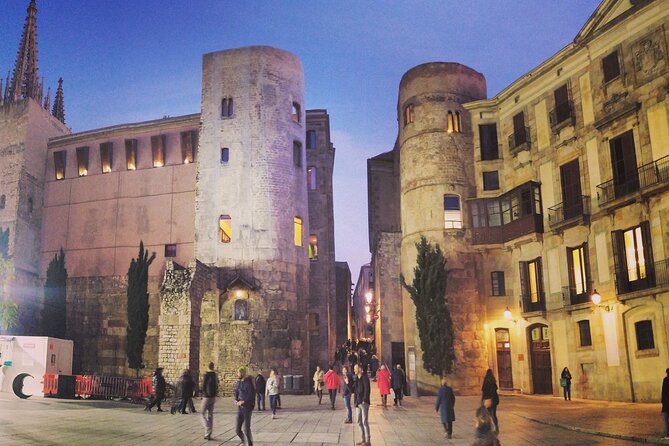
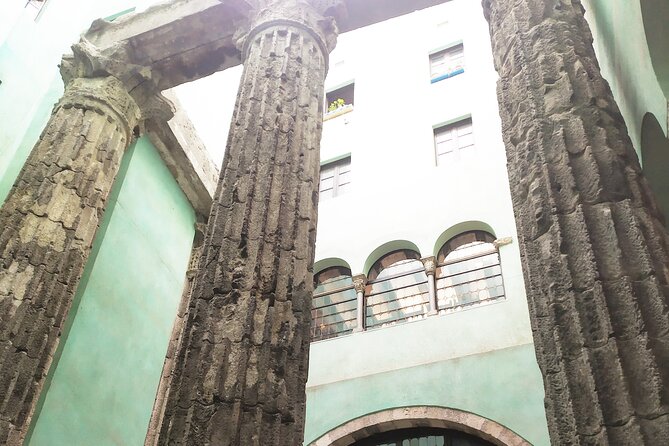
Next is MUHBA Temple d’August, where you’ll encounter one of the oldest layers still visible in Barcelona: four columns from the temple of Augustus, once standing near where you are now.
Even if Roman history isn’t your thing, this stop is worth it because it teaches you how cities change without fully deleting their past. You’re not looking at a textbook. You’re looking at a surviving fragment—proof that Barcelona has been remade repeatedly, while some bones remain.
What I like here is the way Luca connects the Roman era to the city’s later eras. You don’t walk away thinking of Romans as a separate museum world. You leave thinking of them as an origin point—one of the roots you can trace.
And the best part? Admission is free here, so you’re not juggling decisions about tickets while you’re trying to get your head around the storyline.
Catedral de Barcelona: Gothic Outside Views (No Ticket Stress)
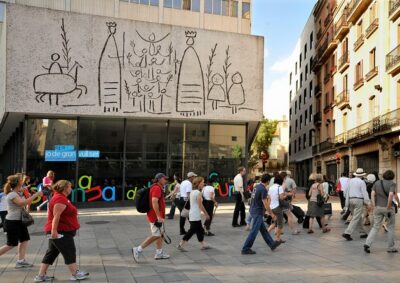
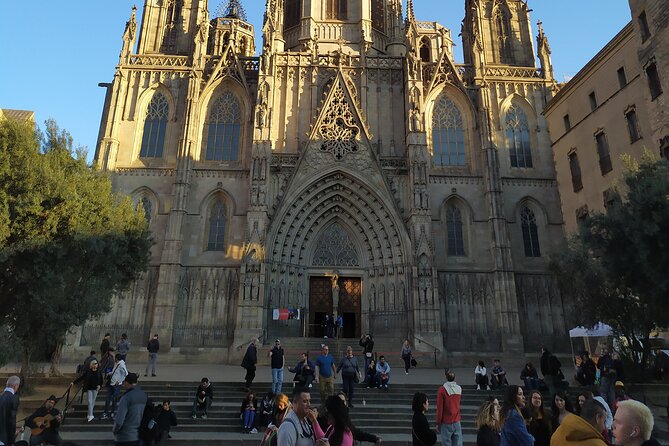
Then you shift to the Catedral de Barcelona. You’ll explore the outside of the Gothic cathedral, not the interior.
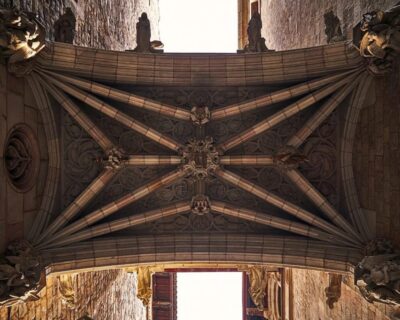
This is a smart move if you want the big architectural ideas without the time cost of an inside visit. You’ll still pick up the look of the Gothic style—the lines, the massing, the way the cathedral anchors the quarter visually. And because you’re keeping the tour moving, you get more variety later.
Important practical note: cathedral admission is not included. That’s fine if your goal is orientation and context. If you’re hoping to go inside, you can plan that as a separate add-on on your own time.
The Gothic Quarter’s Standout Feature (And Why It Matters)
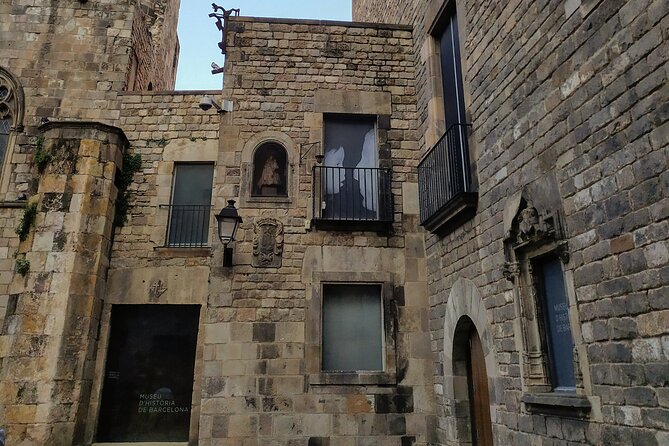
There’s a stop that highlights one of the main features of the Gothic quarter. I won’t pretend you’re going to memorize a single square forever, but Luca’s point is clear: this area has repeating patterns—streets that twist, spaces that feel like rooms, and architecture that carries political weight even when nothing is happening.
This kind of stop is where the tour earns its name. The Gothic Quarter can look like a maze if you’re on your own. With Luca, it becomes a meaningful layout instead of a photo scavenger hunt.


MUHBA El Call + Església de Sant Felip Neri: A Small Route With Big Emotional Range
Two of the most interesting stops land back-to-back: MUHBA – El Call and Església de Sant Felip Neri.
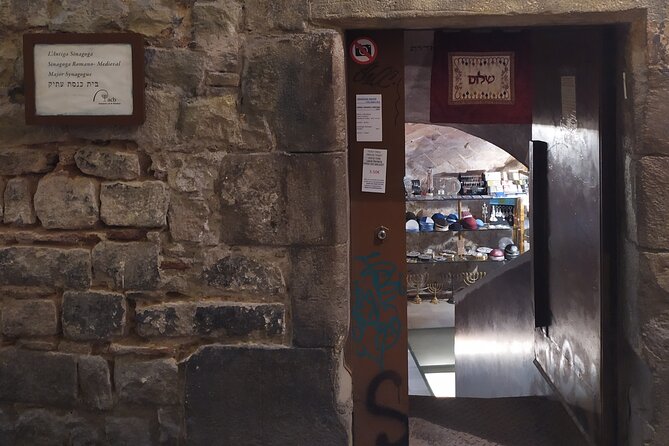
At MUHBA El Call, you’ll step into the story of Barcelona’s Medieval Jewish neighborhood. It’s a powerful counterpoint to the Christian-facing monuments elsewhere on the route. Luca’s framing helps you see the city as a layered home to many communities—not just one dominant narrative.
This stop is free, which makes it easy to justify even if you’re on a tight schedule.
Then you head to Església de Sant Felip Neri, described as Gaudí’s favourite church in his lifetime. That alone is a fun hook. But the church also carries a darker thread: Luca talks about the Spanish Civil War and the recent past tied to this place.
This is the moment where I appreciate how the tour doesn’t treat old stone as harmless decoration. It’s emotional. It has consequences. And Luca’s tone keeps it grounded rather than dramatic for drama’s sake.
Also, the setting matters. You’re in an old-city corner that feels compact and walkable—one of those little spots where you can almost hear the city breathing.
El Born / La Ribera: Medieval Streets That Still Set the Mood
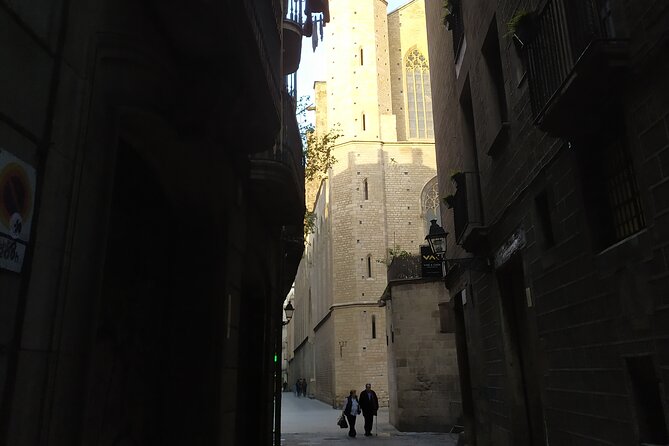
The tour then shifts into El Born / La Ribera, with about 30 minutes here. This is the “linger” section of the walk.
You’re not just passing through. Luca’s approach makes you notice how a medieval neighborhood works: street angles, small squares, the way daily life would have moved around the block. El Born still has that sense of lived-in history, even with today’s cafes and shops in the mix.
If you want a part of Barcelona that feels less like a single monument and more like a whole texture of city life, this is it. It’s also a good time to ask questions, because you’ll have more space to do it.
Santa Maria del Mar: The Church People Actually Care About
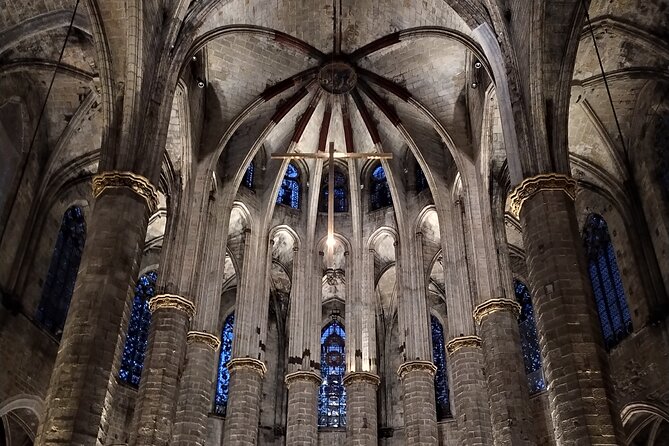
Next is Basilica de Santa Maria del Mar, often described here as the most loved church in Barcelona.
That phrasing matters. This isn’t a church that exists mainly as an architectural object. It’s a centerpiece for a community memory. Luca’s explanations connect why it’s revered, and you’ll likely find it easier to understand once you’ve already walked through the Born neighborhood context.
It’s also a short stop (about 10 minutes), so it won’t eat your afternoon. You’ll get the essentials and then move on.
El Fossar de les Moreres + Passeig del Born: Politics and Play on One Route
The last third turns more overtly political, and it lands with a stop I’d call essential for anyone trying to understand Catalonia today.
You’ll visit El Fossar de les Moreres, framed as a key stop for understanding the political conflict between Madrid and Barcelona. Luca brings this beyond vague slogans. You get a sense of how the past is remembered in the street-level geography—what people built, what they fought over, and what they chose to memorialize.
After that, you close with Passeig del Born, described as the medieval entertainment square of Barcelona. It’s a short stop, but it balances the mood. After heavy history, you end in a space that once hosted daily life and fun. That contrast makes the whole tour feel more human.
Luca’s Tour Style: Energy, Humor, and a Photo Binder Worth the Price
Let’s talk about the guide, because this is where the experience really separates itself.
Luca runs the tour with high energy and keeps the room engaged. He’s the type to have lots of visual references—even a binder with photos—so when he points something out, you’re not guessing what he means. That helps you connect architecture to events without needing a history degree.
I also like how he doesn’t flatten everything into dates. He adds commentary that feels local and sometimes a bit cheeky—like a guide who’s comfortable telling you that historical figures were messy, not statues.
He also makes space for questions, and the Q&A style helps you get answers to the stuff you’re actually wondering about while walking. For many people, that’s what turns a “sights” tour into a “learn how to see” tour.
Price and Logistics: Great Value, Easy Start, Clear Ending
At $13.27, you’re paying for a professional guide and a structured walk through areas that can take you much longer (and feel more confusing) if you’re doing it alone. Most of the stops you’ll hit have free admission, including MUHBA Temple d’August, MUHBA – El Call, and El Born / La Ribera, plus several others marked free.
One exception is the Cathedral admission, which is not included since you’re only touring the outside. If you’re curious to go in, you’ll need to plan that separately.
The tour is in English, uses a mobile ticket, and it caps at 15 people. It’s designed for most people to join, but it’s not suitable for reduced mobility as-is. If you need adaptation, the tour notes it can be adjusted to your pace, or you could arrange a private experience.
The start and end points are also convenient:
- Meet: Pl. de Sant Jaume, 3
- Finish: El Born Centre de Cultura i Memòria (Mercat del Born area)
Ending near the market area is a smart move if you want to keep momentum with food afterward.
Who Should Book This (And Who Might Skip It)
This tour is a great match if you:
- want context fast in the old city
- like walking routes with a clear story
- enjoy history that connects to Catalan identity and conflict, not just kings and dates
- want an easy first look at both the Gothic Quarter and El Born
You might choose something else if you:
- want lots of inside museum time (this is mainly a guided walking route, with some exterior viewpoints)
- can’t handle uneven, outdoor walking for long stretches
If you’re traveling with someone who thinks history is boring, this one often converts them—because Luca explains what you’re seeing in the street, not only what happened long ago.
A Simple Bring-This Checklist for a Summer Walk
This is an outdoor route, so set yourself up for comfort:
- Water (you’ll be glad you did)
- Sun protection if the day is hot and humid
- Comfortable shoes with good grip on uneven old-street pavement
- A little flexibility: this route works best when you’re willing to slow down for explanations and photos
If you’re a heat-sensitive person, I’d time this for earlier in the day when possible. Luca’s route choices can put you in brighter sun at times, and it’s easier to handle if you plan for it.
Should You Book Luca’s Hidden Old Barcelona: Gothic and El Born?
Yes—if you want a high-value, story-driven walk through the places you’ll actually revisit later. For $13.27, you get a tight loop with free MUHBA stops, a cathedral exterior orientation, and a strong political-and-cultural storyline that helps Barcelona feel less like random streets and more like a place with reasons.
I’d book it especially if it’s your first day in town or if you’re short on time but still want more meaning than a self-guided photo loop. The biggest payoff is how Luca turns stone, squares, and churches into a coherent narrative you can carry with you as you wander.
FAQ
How long is Luca’s Hidden Old Barcelona: the Gothic and El Born Tour?
It runs for about 2 hours 15 minutes.
Where does the tour start and end?
The tour starts at Pl. de Sant Jaume, 3, Ciutat Vella, 08002 Barcelona and ends around El Born Centre de Cultura i Memòria / Mercat del Born, Plaça Comercial, 12 in Ciutat Vella.
Is the tour offered in English?
Yes, it’s offered in English.
How big is the group?
The tour has a maximum of 15 travelers.
Do I need to pay for admission at the stops?
Many stops are free (including MUHBA Temple d’August, MUHBA El Call, and others). Catedral de Barcelona outside is listed with admission not included.
Is the tour suitable for reduced mobility?
The tour is not suitable for people with reduced mobility, but it says the operator may adapt the tour to your pace. A private experience could be arranged if needed.