REVIEW · BARCELONA
Enchanting Gothic Quarter by Night Tour
Book on Viator →Operated by Green Tours Barcelona · Bookable on Viator
Night in Barcelona feels like a secret script. This 6pm tour helps you see the Gothic Quarter when it’s calmer, with a guide-led route that links Barcelona’s ancient layers to its modern culture and power. I like the focus on major landmarks plus small details most first-timers miss, and I also like the low-stress pace that works well for an evening walk. One thing to keep in mind: several stops are quick and mostly exterior views, so if you want lots of indoor time, you may leave wanting more.
A big part of the fun is how the guide uses the streets as your lesson plan, from Plaça de la Vila de Madrid’s Roman necropolis to Plaça de Sant Jaume, the city’s government square. And yes, the tour even builds in little breaks, like the stop along Las Ramblas for that playful fountain moment. If you get a guide like Tyler or Paulo, you’ll likely enjoy how clearly they explain what you’re looking at—especially for families.
In This Review
- The vibe: fewer crowds, better stories, and a route that makes sense
- One practical consideration before you go
- What you can expect from the guide
- FAQ
- How long is the Enchanting Gothic Quarter by Night Tour?
- What time does the tour start?
- Where do I meet the tour?
- Where does the tour end?
- Is a mobile ticket included?
- What’s included in the price?
- Are there admission fees at the stops?
- Are churros or gelato included?
- How big are the groups?
- Can I cancel for a full refund?
- Are service animals allowed?
The vibe: fewer crowds, better stories, and a route that makes sense
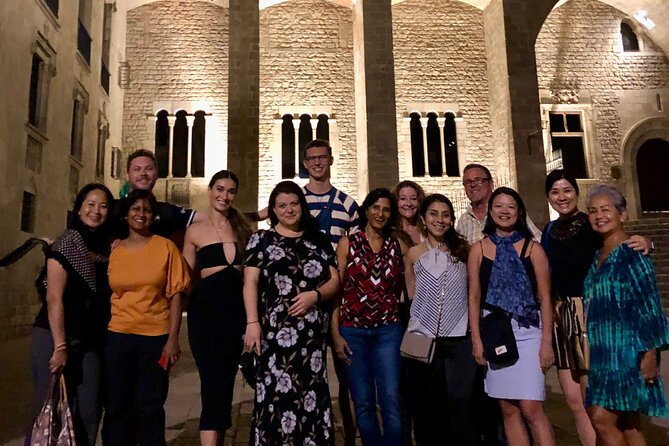
Most Barcelona sightseeing gets scheduled around midday heat and tour-bus crowds. This one starts at 6:00 pm and runs for about two hours, which naturally changes the feel of the Gothic Quarter. The stones cool down, the streets get quieter, and you can actually hear your guide explain why the city looks the way it does.
I also love that the route connects eras in a practical way. Instead of treating the Gothic Quarter like a museum, it shows you Rome beneath the medieval city, then flips to the Cathedral and the squares tied to religion and civic life. It’s a guided walk where you’re constantly orienting yourself.
One practical consideration before you go
The tour is short per stop—most are 5 to 15 minutes—so it’s not a slow stroll where you linger at everything. Also, at Basilica de Santa Maria del Pi, you only visit the outside area, so plan for photo time and street-level architecture reading rather than long interior hangs.
You can also read our reviews of more evening experiences in Barcelona


What you can expect from the guide
The tour runs with a small group (maximum 20), plus it includes photos and images to help you understand what you’re seeing. That matters because Barcelona’s Gothic details can be easy to miss when you’re just wandering. Having a guide point out why something is there—and what it meant—makes the whole walk feel more like comprehension than sightseeing.
- Hard Rock Cafe meet-up at Plaza Catalunya: easy start point in Ciutat Vella, right by major transit.
- Las Ramblas at night: a playful fountain stop gives you a quick break before the deeper history.
- Roman layer under your feet: Plaça de la Vila de Madrid’s necropolis and the Barcino Roman entrance sculpture.
- Cathedral architecture talk: Santa Cruz and Santa Eulalia, where Gothic styles meet.
- Politics in Plaça de Sant Jaume: learn why this square still matters today.
- Human Tower focus at Plaça Sant Miquel: a strong cultural wrap-up and restaurant recommendations to follow.
You meet outside the Hard Rock Cafe Barcelona, in front of Plaza Catalunya (Pl. de Catalunya, 21). For me, the best kind of tour start is the kind that doesn’t make you play guessing games in a maze of streets. This one is anchored on a big landmark and right in the center of everything.
The welcome and intro are quick—about 15 minutes including the initial ticket-handling moment (admission is free for the stops listed). Then you’re moving, and that matters. You want your history tour to get going before your brain starts resisting the walk.
If you’re using public transport, the end point is especially convenient too, but this start is also well placed for reaching quickly from elsewhere in the city. It’s a solid way to start a Gothic Quarter evening without wasting the first half hour trying to locate your group.
Your second stop glides along Las Ramblas, Barcelona’s famous promenade. At night, the atmosphere shifts—more walkable, less hectic, and usually more comfortable than the crush you see midday.
There’s also a little “magical water” moment at a fountain during this stretch. It’s clearly meant to be playful, a light reset before you get into the heavier themes: Roman roots, medieval religion, and civic power.
This part works well if you’re traveling with kids or you just want an evening tour that doesn’t feel like a lecture the whole time. It’s also a helpful way to get oriented: you’re easing into the Gothic Quarter’s geography rather than jumping into it cold.
Next is Plaça de la Vila de Madrid, a square surrounded by pines and jacaranda trees. That vegetation matters because it gives you a visual pause in a tour that’s otherwise all stone and street edges.
Under the story here is the Roman necropolis of the first century AD. This is where the tour does something valuable: it explains origins. Barcelona didn’t begin as a Gothic dream. It grew from earlier, very practical settlement layers, and this stop helps you “read” the city in time order.
You also get a better sense of why the later medieval architecture feels so integrated with the street grid. When you know there’s older ground beneath, you stop thinking of the Gothic Quarter as one era and start seeing it as a stack.
Drawback: this stop is about 15 minutes, so it’s not meant for deep archaeology time. You’re there to grasp the concept and move on.
The tour’s stop at Basilica de Santa Maria del Pi focuses on the Gothic building from the XIV century, with the guide helping you understand what makes regional Gothic architecture recognizable. Importantly, you only visit the outside area here.
That’s a good choice for a night walk. You get the façade and exterior shape without turning the tour into a queue-management exercise. It’s a smart format when your goal is to cover several highlights in two hours.
If you’re the type who likes to spot patterns—arches, stone work, and the overall vertical feel—this stop will land. If your travel style is, I want to go inside every church, you’ll probably want to add a separate daytime visit later.
Next comes Esculptura de lletres Barcino, described as an ancient entrance connected to the Roman villa Barcino dating from the 1st century BC. It’s an understated stop, but it’s the kind of detail that upgrades the entire tour experience.
Here’s why it matters for you: once you’ve connected Barcino to the idea that Rome left physical clues in the city, you start looking at other streets with better questions. You stop seeing random corners and start seeing why certain places feel placed exactly where they are.
Even though the stop is about 10 minutes, it can be one of the most memorable moments because it changes your mental map. Barcelona becomes less postcard and more “how it formed.”
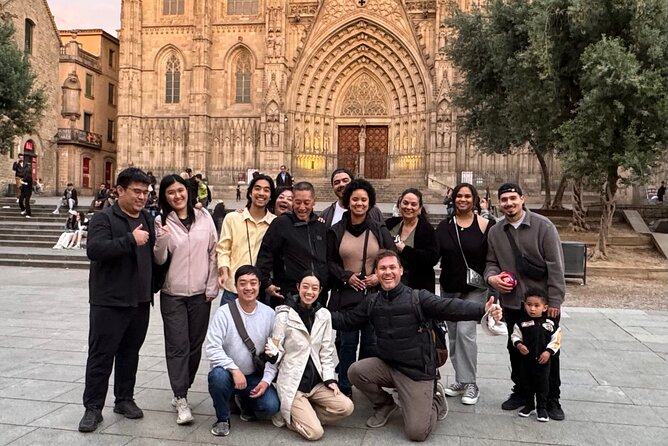
At Barcelona Cathedral, you’ll learn about the Cathedral of Santa Cruz and Santa Eulalia—specifically, how medieval Gothic and Neo Catalan Gothic meet in the building’s overall look. You also get a chance to talk about religion, architecture, and local culture.
This is one of the stops where a good guide can make a big difference, because cathedral architecture isn’t always obvious at street level. Having a guide explain what you’re looking at helps you notice the style transitions and understand why locals value this building beyond just the famous name.
Just after that is Placa del Rei, home to the Royal Palace and the Chapel of Santa Agatha nearby. The emphasis here is on vestiges of kingdoms that still feel anchored in the heart of the Gothic Quarter.
This pairing—Cathedral first, then Plaça del Rei—helps your brain build a storyline: spiritual authority and civic/royal authority aren’t separate themes in Barcelona. They overlap, and the squares show that.
Quick note: these are still short stops, roughly 15 minutes each, so expect viewing and explanation, not extended time at every corner.
One of the most charming (and slightly odd) stops is Caganer. You’ll get a brief stop to appreciate Barcelona’s jocular culture, explained as the pooper. It sounds silly, and that’s the point. This is a reminder that tradition doesn’t have to be solemn all the time.
Then you move to Placa de Sant Jaume, the government plaza where the guide comments on the current political situation of the city. This part gives the tour a strong modern edge. You’re not only learning about old stones—you’re seeing how today’s politics lives in the same public spaces where power has been discussed for centuries.
For me, this is where the tour becomes more than architecture spotting. When a guide connects historic sites to the present, you leave the walk feeling like you understand why Barcelona feels intense and specific rather than generic and touristy.
Drawback: if you’re sensitive to political conversation or you prefer strictly historical content, just know this stop includes that angle.
The tour ends at Placa Sant Miquel, with the monument tied to the traditional Human Tower of Catalonia. This is a strong closing note because it shifts you from Gothic stone to living Catalan identity.
The timing also works. The tour wraps up in about five minutes at this last square, and then you get a list of local restaurant recommendations. That’s useful because it turns the night walk into an immediate plan. You’re not stuck staring at your phone thinking, what should we eat now?
After the tour, you have the optional suggestion to enjoy churros and hot chocolate or gelato at your own expense. It’s a classic Barcelona way to cap the evening.
At $21.69 per person for about two hours, this tour sits in the budget-friendly zone for a guided walk in central Barcelona. The value isn’t just that it’s cheaper than some attractions. It’s that you get a real guide plus photos and images to support what you’re seeing.
A key detail: the listed stops are marked as free in terms of admission. That means you’re paying for guidance and interpretation, not for multiple entrance fees. With a maximum of 20 travelers, you should also get more attention than you would on larger, busier group walks.
Booking wise, it’s commonly reserved around 40 days in advance on average. If you’re traveling in a busy period, I’d rather you lock it in early than hope an evening slot stays open.
One more value factor: this tour gives you a night option. Many sightseeing tours only work well in the morning. If you want a plan that uses the cooler hours, this fits.
This is a good match if:
- You want to walk the Gothic Quarter at 6pm with a calmer pace.
- You like the idea of mixing Roman, medieval, and modern civic culture in one route.
- You appreciate explanations that help you connect architectural details to meaning.
- You’re traveling as a small group and want something structured but not exhausting.
It’s less ideal if:
- You need lots of indoor time or long museum-style stops.
- You don’t enjoy short stops and prefer slower, more flexible wandering.
- You want a tour that stays purely historical, with no commentary about present-day politics.
- Wear shoes that handle uneven old-street surfaces. Night tours can mean you notice cobblestones more than you planned.
- If you’re sensitive to walking time, remember most stops are 5 to 15 minutes. Plan a rest break for later.
- If you love food, keep some room after the tour for churros with hot chocolate or gelato, since those are optional and on your own.
I think you should book this tour if you want a smart, guided way to understand why the Gothic Quarter feels like a layered story. The route connects Roman origins, Gothic landmarks like the cathedral, and civic life at Plaça de Sant Jaume, and it does it at a comfortable evening hour.
I’d be a little cautious if you’re the type who needs a fully indoor experience, since several stops are exterior and many segments are short. Also, keep in mind there has been at least one reported issue where a guide didn’t show up. To protect yourself, be sure you can confirm details close to departure and have a backup plan for your evening if anything goes off track.
If your goal is clear: get oriented fast, see the highlights at night, and leave with more than photos—this is a solid pick.
FAQ
How long is the Enchanting Gothic Quarter by Night Tour?
It runs for about 2 hours.
What time does the tour start?
The start time is 6:00 pm.



Where do I meet the tour?
You meet outside Hard Rock Cafe Barcelona at Pl. de Catalunya, 21, Ciutat Vella, 08002 Barcelona, Spain.
Where does the tour end?
The tour ends at Plaça de Sant Jaume, Pl. de Sant Jaume, Ciutat Vella, 08002 Barcelona, Spain.
Is a mobile ticket included?
Yes. The tour uses a mobile ticket.
What’s included in the price?
A tour guide is included, along with photos and images to help you understand the tour.
Are there admission fees at the stops?
The tour lists the stops as admission ticket free.
Are churros or gelato included?
No. Churros con Chocolate and gelatto or ice cream are not included, but you can enjoy them at the end at your own expense.
How big are the groups?
The tour has a maximum of 20 travelers.
Can I cancel for a full refund?
Yes, you can cancel up to 24 hours in advance for a full refund.
Are service animals allowed?
Yes, service animals are allowed.