REVIEW · BARCELONA
Barcelona in 2 Hours: Guided Walk Through History and Sights
Book on Viator →Operated by Carpe Diem Tours · Bookable on Viator
Barcelona history becomes legible fast. In two hours, you move through the Gothic Quarter and El Born with a local guide who connects art, architecture, and Catalan identity through real places like Els Quatre Gats. You’ll leave with names, timelines, and street-level context that make later museum visits click. Els Quatre Gats is where the tour’s “why this city matters” tone really takes hold.
What I like most is the focus on story over postcard facts. You get quick explanations at major sites (plus a few surprising ones), and the route links Pablo Picasso and Antoni Gaudí’s creative hangout to Later political history tied to Catalonia Day. Second, the tour is good value because it’s priced at $22.99 for a 2-hour guided walk with a small group cap of 20 and a mobile ticket—so you spend your time walking, not figuring things out.
One thing to consider: two major stops have admission not included (the Catedral de Barcelona and Basilica de Santa Maria del Mar). If you’re aiming to go inside, budget extra, and if you hate crowds or don’t enjoy hearing stories while you walk, you might prefer a slower, museum-style plan.
In This Review
- Key things to notice before you go
- Why a 2-hour Gothic Quarter walk works so well
- Price and value: $22.99 for a guided story circuit
- The route in plain English: from Els Quatre Gats to Santa Maria del Mar
- Stop-by-stop: what you’ll see and what to look for
- Els 4 Gats: where Picasso and Gaudí connect to real street life
- El Mon Neix En Cada Besada: street art with a date attached
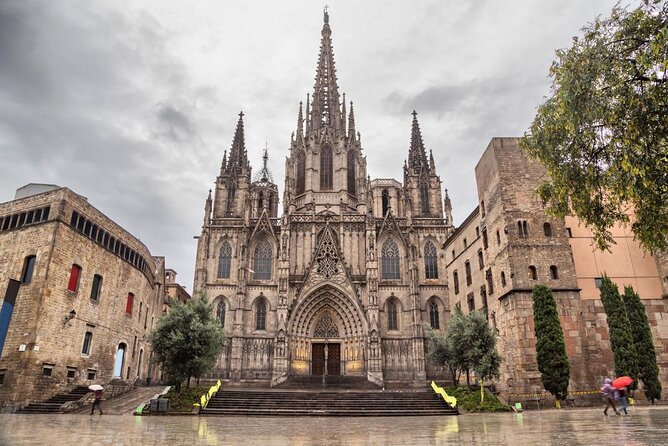
- Catedral de Barcelona: Gothic drama and Eulalia’s story
- Casa de l’Ardiaca: small building, big timeline
- Pont del Bisbe: the legend you can’t un-hear
- Placa Sant Felip Neri: a square with scars
- MUHBA – El Call: medieval streets and Jewish neighborhood history
- Plaça de Sant Jaume: where government and protest share the same air
- Plaça del Rei: Royal Palace and the shadow of the Inquisition
- Plaça de l’Àngel: from Wheat Square to a miracle moment
- Basilica de Santa Maria del Mar: Gothic beauty with maritime roots
- Getting the most from your guide: energy, clarity, and smart tips
- Who this tour suits best (and who should skip it)
- Planning your day after the tour
- Should you book Barcelona in 2 Hours?
- FAQ
- How much does Barcelona in 2 Hours cost?
- How long is the tour?
- Is the tour offered in English?
- What’s the maximum group size?
- Where does the tour start and end?
- Do I need to buy admission tickets during the tour?
- Do I need paper tickets?
- What’s the cancellation policy?
Key things to notice before you go
- Art and politics in the same walk: Picasso and Gaudí show up alongside Catalan defeat commemorations and inquisition-era reminders.
- A tight 2-hour route: you hit landmark squares, churches, and medieval streets without needing half a day.
- Mostly no extra ticket cost at stops: several sites are marked free on the tour route, while two are not.
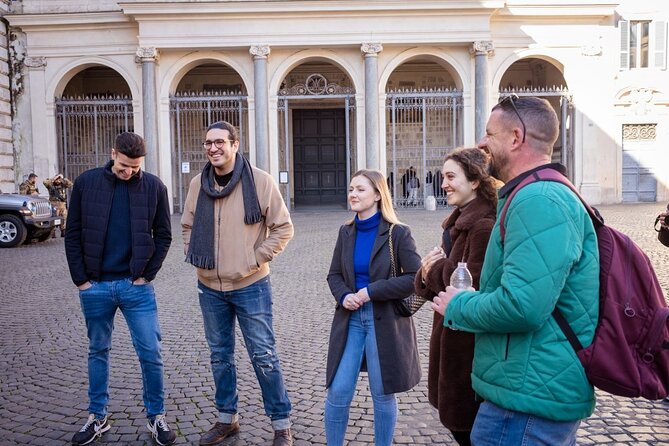
- Small groups (max 20): this helps you ask questions and actually follow the guide’s thread.
- Superstition meets architecture at Pont del Bisbe, where the legend is part of the experience.
- Guide variety is real: your guide can shape the energy, clarity, and even food suggestions like Tapas 2254.
Why a 2-hour Gothic Quarter walk works so well
Barcelona can feel like it’s made of “big sights” and “big waits.” This tour cuts through that by keeping the pace human and the explanations practical, so you understand what you’re looking at while you’re still there.
You’ll also get a strong sense of how Barcelona’s identity layers over time. You’ll walk past Gothic churches and old Jewish streets, then end at the sea-minded Gothic Santa Maria del Mar area—so the city doesn’t read like disconnected eras. It reads like one long conversation.
And yes, it’s short. But short here doesn’t mean thin; the guide’s job is to give you enough context to make the rest of your trip smarter.
You can also read our reviews of more walking tours in Barcelona



Price and value: $22.99 for a guided story circuit
At $22.99 per person for about 2 hours, this is aimed at travelers who want momentum on their first day. You’re paying for local interpretation and a route that touches the places most people miss when they’re self-guiding.
The value gets better because many stops on the route are listed with admission ticket free (for example, Els 4 Gats, Pont del Bisbe, Casa de l’Ardiaca, and several squares). The tour still keeps movement efficient even when a stop doesn’t require paid entry.
The only real “value leak” is that the Catedral de Barcelona and Basilica de Santa Maria del Mar are marked admission not included. If you plan to go inside both, you’ll want to add that cost on top and not treat it as a fully prepaid museum pass.
The route in plain English: from Els Quatre Gats to Santa Maria del Mar
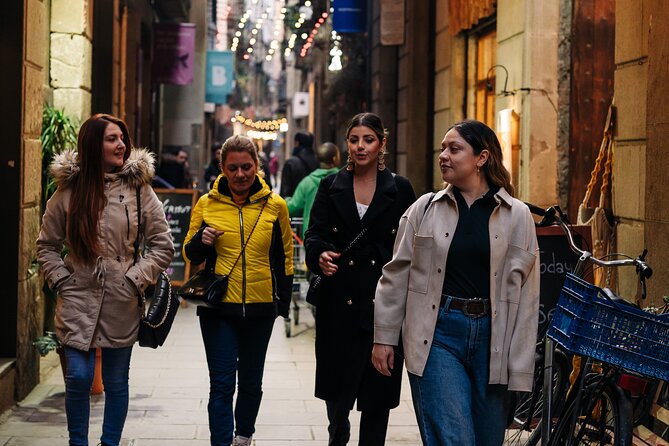
You start in Plaça del Vuit de Març in Ciutat Vella, then work your way through the Gothic Quarter toward El Born, finishing at Basílica de Santa Maria del Mar in Ciutat Vella. That’s a smart arc because it keeps the “old city” feeling intact while walking through multiple neighborhoods that feel different underfoot.
Along the way, the tour uses a mix of:
- a famous old café and art-world hangout
- public art tied to national events
- churches and squares tied to faith and civic power
- the medieval Jewish quarter and city governance spaces
So even if you’re not chasing history as a hobby, the route helps you read the street layout and the symbolism without a long lesson.
Stop-by-stop: what you’ll see and what to look for
Els 4 Gats: where Picasso and Gaudí connect to real street life
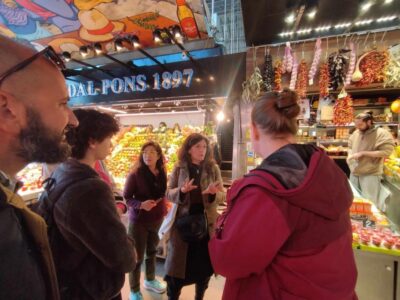
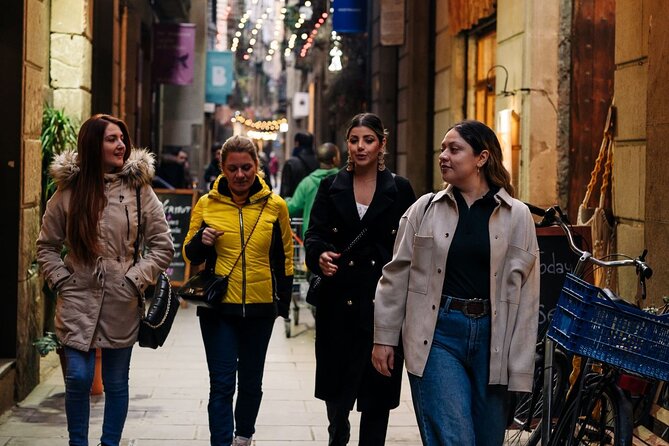
At Els 4 Gats, the tour leans into a simple idea: famous art ideas often start in ordinary rooms. This historic café and restaurant is linked to the meeting culture loved by creative minds, including Pablo Picasso and Antoni Gaudí.
Look for the exterior character and Art Nouveau feel; it’s not just decorative. It’s the “why this city gets called artistic” lesson in one stop, and it sets the tone for the rest of the walk.
Admission is marked free here.
You can also read our reviews of more guided tours in Barcelona


El Mon Neix En Cada Besada: street art with a date attached
This photomosaic is often treated like a quick photo stop. The better way to experience it is to remember the story underneath: it connects to the Catalan defeat on September 11, 1714, and the later celebration of La Diada.
While you’re there, notice how the city uses public space to keep memory visible. That’s a theme you’ll see again in squares tied to power, protest, and religion.
Admission is marked free.
Catedral de Barcelona: Gothic drama and Eulalia’s story
The Cathedral of Barcelona is a multi-century Gothic church in the heart of the city. The tour focuses on the life and death of Eulalia, the city’s patron saint, and how her story shaped the church’s meaning.
If you’re standing outside or just moving past quickly, you can still catch the “Gothic layers” feel—structures grown over time rather than built all at once. If you’re willing to pay entry, this stop is where your attention usually widens, because the story is bigger than the street view.
Admission is marked not included.
Casa de l’Ardiaca: small building, big timeline
This is one of those stops that works because it’s compact. Casa de l’Ardiaca is described as a tiny architectural wonder in the Gothic Quarter, mixing Gothic and Renaissance elements.
What to watch for: the Roman reminders. The tour points to wall remnants and arcades tied to an old aqueduct that once supplied Barcino with water. That’s a neat reality check that you’re walking over infrastructure, not just monuments.
Admission is marked free.
Pont del Bisbe: the legend you can’t un-hear
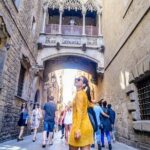
Bishop’s Bridge is famously photographed, but the tour adds something useful: the legend attached to it. Whether you believe superstition or not, the point is that Barcelona’s old city has rules—some official, some rumored—and both shape how people move.
If your guide mentions what to do (or what not to do) under the bridge, it’s worth listening. It turns a short crossing into a cultural moment, not just a snapshot.
Admission is marked free.
Placa Sant Felip Neri: a square with scars
This square is described as hidden and tied to Catalan independence. The tour leans into why the place feels sombre rather than scenic, emphasizing the tragic past connected to the independence desire.
Take a minute to notice how squares can be emotional even when there’s no museum label. In Barcelona, public space often carries political memory.
Admission is marked free.
MUHBA – El Call: medieval streets and Jewish neighborhood history
MUHBA – El Call brings you into the medieval quarter linked to Barcelona’s former Jewish community. The tour presents it through narrow streets and architecture you can actually feel under your feet.
You don’t need to treat this like an indoor exhibit. The layout alone helps you grasp the “lived-in” nature of historic neighborhoods—compact, walkable, and shaped for daily life.
Admission is marked free.
Plaça de Sant Jaume: where government and protest share the same air
This is the main civic square, tied to the seat of the Catalan government and City Hall. The tour frames it as a place of both celebration and protest, with an important figure tied to one of the beloved holidays of the year.
Even if you don’t know Catalan political terms yet, the scene makes sense quickly. You’re standing in a political stage. And Barcelona is a city where that stage matters.
Admission is marked free.
Plaça del Rei: Royal Palace and the shadow of the Inquisition
Plaça del Rei is about power and punishment. The tour connects it to the Royal Palace and brings up the city’s dark past during the Spanish Inquisition.
This is the stop where you’ll probably feel the shift from art-and-life Barcelona to consequences-and-control Barcelona. It’s useful context if you’re also planning to visit other history sites on your own.
Admission is marked free.
Plaça de l’Àngel: from Wheat Square to a miracle moment
This square was once known as Wheat Square, tied to grain trading. The tour explains why it was renamed Angel’s Square after an apparition appeared during the procession of Saint Eulalia’s body.
Watch how the same place can hold both commerce and religion in its identity. That combination shows up again and again in old-town cities—what changes is the story people tell about the same streets.
Admission is marked free.
Basilica de Santa Maria del Mar: Gothic beauty with maritime roots
You finish at Basilica de Santa Maria del Mar, in the El Born area. The tour presents it as a Gothic basilica connected to Barcelona’s maritime history, which is a great final clue for why this city tastes salty and ambitious.
This is one of those endings that makes you slow down. Even if you don’t go inside, the setting around the basilica makes the earlier stops feel more complete.
Admission is marked not included.
Getting the most from your guide: energy, clarity, and smart tips
What really drives the success of this tour is the guide’s pacing and storytelling style. The experience is offered in English, and your leader’s clarity can make the difference between “I saw a lot” and “I finally get it.”
Across guide styles, a few patterns show up in the kind of help you’ll want:
- A high-energy host who keeps the route conversational, like Darren, Lydia, Sarah, or Sonja
- A guide who adds architectural and archaeology angles, such as Sonia
- A guide who adds local navigation help and off-route suggestions, like Jorge
If you get Sonia specifically, there’s an extra bonus: a recommendation for Tapas 2254 came up as a good pick tied to the route vibe. Even if you don’t follow the exact restaurant, that’s the kind of practical food-and-walk advice that makes a short tour pay off later.
One practical note: there’s at least one reported issue where background noise made it harder to catch details, and a guide didn’t have a speaker or audio aid. If you’re sensitive to sound in busy areas, take it as a heads-up—hold your attention, ask questions when possible, and don’t be afraid to request repetition.
Also, take the basics seriously: bring good walking shoes and sun protection. Two hours sounds short until you’re doing it under full old-town sun.
Who this tour suits best (and who should skip it)

This fits best if you’re:
- visiting Barcelona for the first time and want your bearings fast
- short on time but still want real cultural context
- interested in how art, religion, and politics show up in everyday streets
- the type who likes asking questions during a walk
You might skip it if you:
- want long, quiet interior time in cathedrals and basilicas
- hate walking in dense areas with changing streets and small crowds
- prefer a museum-first plan with timed entry and deeper stops
It’s also a good “warm-up” tour before you choose which single neighborhood to explore longer.
Planning your day after the tour
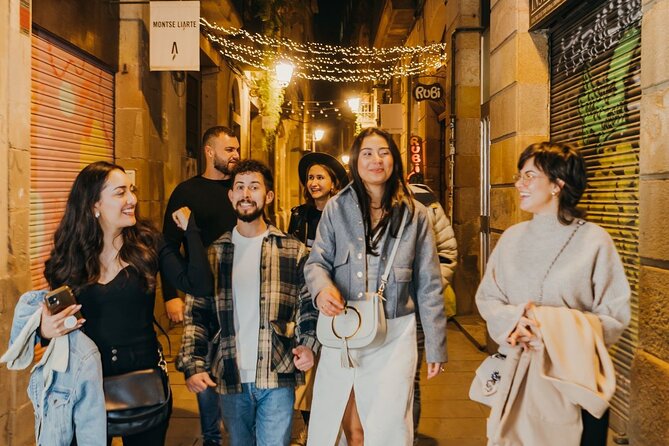
Because you end near Santa Maria del Mar and El Born, you’ve basically landed where you can keep moving without backtracking. Use the story thread your guide gave you to pick one direction:
- If the political history theme grabbed you, linger around the squares and civic spaces and read the urban layout more carefully.
- If the faith-and-saint stories stuck, return to the cathedral/basilica area and spend more time in the interiors you didn’t enter yet.
- If the art angle is your thing, revisit streets where the public art and creative hangout energy showed up, then add a museum visit later with better context.
This is also when your guide’s food suggestions can work well. A tapas meal right after a walking tour hits the sweet spot: you’ve just learned the place, and now you taste the city.
Should you book Barcelona in 2 Hours?
I’d book it if you want a guided “story map” of old Barcelona in about two hours, especially at the start of your trip. The price is fair for what you get, and the route hits the kinds of places you’d otherwise struggle to interpret quickly on your own.
I wouldn’t treat it like a full entry-packaged sightseeing ticket, though. With Catedral de Barcelona and Basilica de Santa Maria del Mar marked admission not included, you should decide ahead of time whether you’ll pay for interiors.
If you can walk comfortably for a couple hours, like learning from a local guide, and want the city’s art and Catalan identity to connect in your head, this is a smart, efficient booking. It helps you see Barcelona instead of just looking at it.
FAQ
How much does Barcelona in 2 Hours cost?
It costs $22.99 per person.
How long is the tour?
The tour runs for about 2 hours.
Is the tour offered in English?
Yes, it’s offered in English.
What’s the maximum group size?
The tour has a maximum of 20 travelers.
Where does the tour start and end?
It starts at Plaça del Vuit de Març, Ciutat Vella, 08002 Barcelona and ends at Basílica de Santa Maria del Mar, Plaça de Santa Maria, 1, Ciutat Vella, 08003 Barcelona.
Do I need to buy admission tickets during the tour?
Many stops are marked with admission ticket free, but Catedral de Barcelona and Basilica de Santa Maria del Mar are marked as admission not included.
Do I need paper tickets?
No. The tour includes a mobile ticket.
What’s the cancellation policy?
You can cancel for a full refund with free cancellation up to 24 hours before the experience starts.