REVIEW · BARCELONA
Private Barcelona Highlights: Gothic Quarter with a Local Guide
Book on Viator →Operated by Eternal Experiences · Bookable on Viator
Some cities reward you; Barcelona rewards you fast. This 2-hour, guided walking highlights route helps you understand the Gothic Quarter as you walk it, with stops tied to artists, saints, and Catalan power. I like that you get great time-saving direction on foot, and I also like the mix of art, architecture, and the human stories behind the stones.
One possible drawback to plan for: you are walking through tight streets and squares, and the main cathedral and basilica stops have admission not included, so you may need extra time or a separate ticket choice depending on how the sites are running when you visit.
If you’re choosing a first Barcelona walk, this one is practical. With a maximum of 20 people and a 6:00 pm start, it’s sized for conversation, and the meeting point is in the center of Ciutat Vella so you can plug it into your first evening.
In This Review
- Key highlights at a glance
- Tour basics: timing, pace, and what you actually get
- Getting oriented fast in Barri Gòtic
- Els 4 Gats: where Barcelona’s artists rubbed shoulders
- El món neix en cada besada: the mural that turns into a story
- Catedral de Barcelona: Saint Eulàlia as the city’s “heartbeat”
- Casa de l’Ardiaca: Roman Barcelona still hiding in plain sight
- Pont del Bisbe: a bridge with a legend
- Placa Sant Felip Neri and MUHBA El Call: war scars and Jewish neighborhood memory
- Plaça Sant Jaume and Plaça del Rei: Catalonia’s power, then the Inquisition’s shadow
- Plaça de l’Àngel and Santa Maria del Mar: trade, procession, and a maritime heartbeat
- Price and value: why $180 can be worth it (or not)
- Things to watch for: guide style, hearing, and expectations
- Who this walking tour is best for
- Should you book this Gothic Quarter highlights walk?
- FAQ
- How long is the Private Barcelona Highlights tour?
- Where do you start and where do you end?
- Is the tour in English?
- What attractions are included, and is entry included?
- How large is the group?
- What is the cancellation option?
Key highlights at a glance
- Small group feel (up to 20) keeps the pace manageable and questions possible
- Gothic Quarter focus means fewer detours and more “why this matters”
- Photo-ready art stops like the World Begins With a Kiss mural
- Big landmarks plus street-level details (cathedral, Roman leftovers, squares)
- Site tickets are mostly free—but Barcelona Cathedral and Santa Maria del Mar are not
Tour basics: timing, pace, and what you actually get

This tour runs for about 2 hours, starting at 6:00 pm and ending near Basilica de Santa Maria del Mar. That timing matters. In the evening, the Gothic Quarter feels less like a map exercise and more like a real neighborhood—especially as light turns the stone warmer and the streets start to thin a bit.
You’ll meet at Plaça del Vuit de Març in Ciutat Vella (Ciutat Vella, 08002). The route is designed to work on foot, with multiple short stops (roughly 10 minutes each). That format is ideal when you want history without committing an entire day to one monument.
You get an English-speaking local guide, a mobile ticket, and general “city highlights + hidden gems” coverage. It’s also booked ahead often (around 33 days on average), so if you’re traveling at a busy time, early booking is smart.
On the value side, $180.22 can sound steep for a walking tour until you think about what you’re paying for: direction (so you don’t wander in circles), interpretation (so the place has meaning), and a route that strings together the area’s best “context stops” without long travel time.
You can also read our reviews of more guided tours in Barcelona

Getting oriented fast in Barri Gòtic

If you’ve ever wandered the Gothic Quarter and later realized you never really learned anything, this tour style solves that problem. The guide keeps you moving in a logical flow through the old center, so you connect squares to buildings instead of seeing them as random photo stops.
A big win here is the “don’t get lost” angle. Barri Gòtic can feel like a maze. When you have a guide steering you, you’ll spend your effort looking at details instead of trying to decode street grids.
I also like that the tour’s center of gravity stays in the Ciutat Vella zone: Gothic streets, Roman traces, medieval squares, and the adjacent El Born area. That means less “travel time tax” and more time spent absorbing what makes Barcelona distinct—without needing multiple tickets just to start.
Els 4 Gats: where Barcelona’s artists rubbed shoulders
The first stop is Els 4 Gats (often tied to the famous Art Nouveau building Casa Martí). This is one of those places where “food stop” and “cultural landmark” overlap. Even though the stop is short, it sets the tone: Barcelona isn’t only gothic stone and ancient walls. It also has a modern creative streak.
What I find useful about starting here is that it gives you a lens. You stop not just to look, but to learn that artists like Pablo Picasso and Antoni Gaudí were associated with the space. That helps when you later see Barcelona’s architecture with more than one layer in mind.
Admission at this stop is free, which is helpful. It also means you’re not forced into the early “ticket math” when you’re still getting your bearings.
El món neix en cada besada: the mural that turns into a story
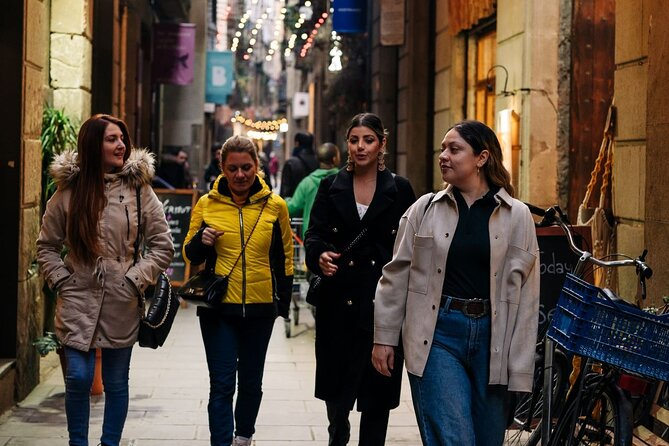
Next up is the photo-friendly mural El món neix en cada besada, linked to the idea known in English as The World Begins With a Kiss. This is an excellent stop if you like your history in a human way.
A lot of travelers speed past modern art or street icons in old neighborhoods. This stop does the opposite: it ties the image to the city’s cultural identity and Catalonia’s historical mood. Even in 10 minutes, it gives you something to remember beyond a view.
Admission is free, so you can treat it as both a quick visual break and a meaning check-in.
Catedral de Barcelona: Saint Eulàlia as the city’s “heartbeat”
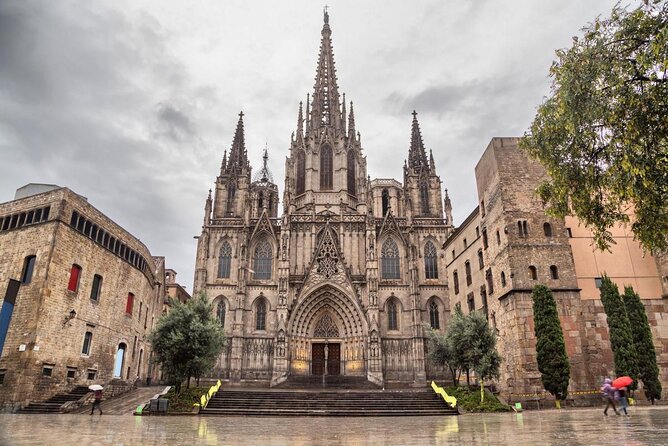
Then you get to Catedral de Barcelona, the center of gravity for Barri Gòtic. This is where the tour’s tone leans fully into “place as story.” The guide frames the cathedral through Eulalia, Barcelona’s patron saint.
This matters because Gothic architecture can be intimidating if you just look at it as style. When you have a name and a narrative thread—saint, legend, city identity—the building becomes easier to read.
One practical note: the cathedral admission is not included. So if you want to go inside, be ready to either buy a ticket separately or accept that you may just get the exterior experience during the scheduled time.
You can also read our reviews of more private tours in Barcelona





Casa de l’Ardiaca: Roman Barcelona still hiding in plain sight
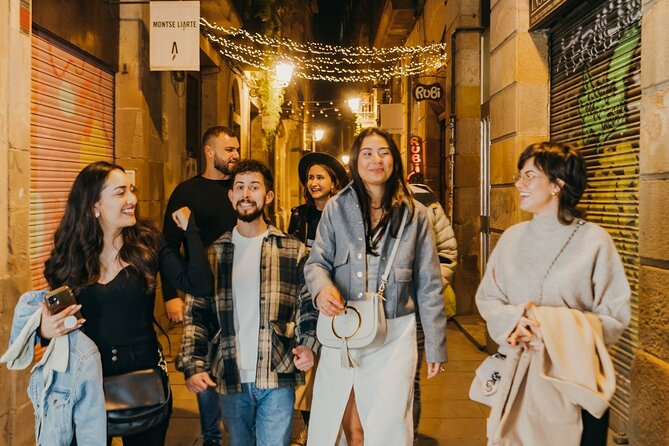
At Casa de l’Ardiaca, you time-travel in a way that feels more grounded than grand museum hopping. The site connects Barcelona’s old Roman footprint (the colony of Barcino) to what you can still see around you.
This is where you’ll learn about remnants like a Roman wall and arcades associated with aqueduct structures—details that make the city feel layered instead of frozen in one era.
Admission here is free, which helps you enjoy the stop without extra costs. It’s also a great contrast after the cathedral: holy stone above, Roman engineering below, all within the same “old city” bubble.
Pont del Bisbe: a bridge with a legend
Pont del Bisbe (the Bishop’s Bridge) is one of those “small structure, big story” moments. The tour treats it like a mini-history stop, including the legend tied to the bridge.
This is a good example of why having a guide helps. From the street, it’s easy to see a bridge. With context, you start seeing why a bridge mattered: movement, boundaries, power, and local folklore.
Admission is free, so it’s mostly about listening and looking.
Placa Sant Felip Neri and MUHBA El Call: war scars and Jewish neighborhood memory
Two of the stops in this route lean into darker chapters of Barcelona, which is valuable if you want a complete picture instead of a postcard version.
At Plaça Sant Felip Neri, you’ll learn how the square carries scars from the Spanish Civil War. Even if you don’t plan to become a full-time political-history reader, these kinds of stops change how you understand the city. The stones stop being background and start being evidence.
Then comes MUHBA – El Call, the former Jewish neighborhood. The tour points you toward the idea that El Call holds stories including an ancient synagogue and local legends. This is also an important kind of stop because it reminds you Barcelona’s history was not only shaped by one group or one religion.
Admission is listed as free for these stops, making them easy to fit into the walking flow without added ticket pressure.
Plaça Sant Jaume and Plaça del Rei: Catalonia’s power, then the Inquisition’s shadow
These two squares are where Barcelona turns into politics in stone.
Plaça de Sant Jaume is framed as the seat of the Catalan government and the city’s administrative core, plus stories tied to the beloved saint. This is one of those places where “what government looks like” becomes visible. You’ll likely find yourself paying attention to how buildings are arranged around authority.
Then Plaça del Rei brings a darker angle: the Royal Palace and the shadow of the Spanish Inquisition. This isn’t just a scary footnote. It’s part of how the city’s identity formed, and it helps explain why Barcelona’s relationship to power has always been complicated.
Both stops are listed as free, so again, you’re paying for interpretation more than entrances.
Plaça de l’Àngel and Santa Maria del Mar: trade, procession, and a maritime heartbeat
The route ends in a way that helps you broaden the story beyond the gothic walls.
Plaça de l’Àngel is described as once part of the grain trading hub and later tied to a heavenly apparition involving Saint Eulàlia and a procession. Even if you only catch the “grain trade to procession” idea in your mind, it’s a useful reminder: Barcelona wasn’t just religious ceremony; it was also daily food logistics and civic ritual.
Finally, Basilica de Santa Maria del Mar is in the El Born area. The tour frames it as a testament to the city’s maritime history. That’s a key angle because Barcelona’s identity isn’t only inland walls and gothic churches. The sea shaped wealth, building projects, and social life.
Admission for Santa Maria del Mar is not included, so treat this as the place where you might decide whether you want to pay for the interior experience. Either way, the stop is a strong finishing point and an easy place to continue your evening plans.
Price and value: why $180 can be worth it (or not)
$180.22 for about 2 hours is not a casual impulse price. But it can make sense if you care about three things:
- You want orientation. With a guide, you’ll connect where you are to what you’re seeing.
- You don’t want ticket chaos. Most stops on this route are marked as free admission; the two big exceptions are the cathedral and Santa Maria del Mar.
- You prefer storytelling over scanning plaques. Several guides on similar-style tours are praised for keeping the walk engaging with myths and anecdotes, which is exactly what turns corners into understanding.
When might it not be worth it? If you mainly want Sagrada Família, this walk is not built around it. One guest felt disappointed because the tour did not meet expectations about Sagrada Família coverage. So if Sagrada Família is your #1, pair this with a separate Sagrada visit instead of assuming it will be included.
Things to watch for: guide style, hearing, and expectations
Most experiences score extremely high, which usually means the guides are doing a solid job. Still, one caution stands out from the feedback: guide delivery can vary.
- One concern was about a guide using inappropriate language around children. If you’re traveling with kids, it’s fair to consider that this is a listening-heavy tour and you should choose guides whose style fits your family values.
- Another small note: in a couple of cases, hearing was harder. If you’re sensitive to sound, you may want to bring your own earbuds, if that’s allowed by the operator. The goal is simple: don’t miss the guide’s explanations.
- Finally, some people felt that a few anecdotes weren’t entirely factual. For me, that’s not automatically bad. Many tours use legend and myth to make places stick. Just keep in mind that you might hear story versions, not only academic proofs.
Who this walking tour is best for
This one fits best when you’re:
- seeing Barcelona for the first time and want a fast, structured intro to the Gothic Quarter
- the kind of traveler who likes why questions, not only what questions
- happy to walk a lot in a compact area with short stops
It also works well as a “start here” evening. Ending near Santa Maria del Mar can set you up for dinner and an easy follow-on stroll in El Born.
Should you book this Gothic Quarter highlights walk?
I’d book it if you want a guided, high-density orientation walk through Barri Gòtic and the nearby El Born edges, especially if you like saints, legends, and the feeling of stepping through layers of Barcelona’s timeline.
Skip or add a separate plan if:
- Sagrada Família is your top must-see and you need it on this exact tour
- you want entrances included for major churches and basilicas, since Barcelona Cathedral and Santa Maria del Mar list admission as not included
- you have strong preferences about humor level or family-appropriate language
If your goal is to understand the old center without getting lost, this is a strong match.
FAQ
How long is the Private Barcelona Highlights tour?
It runs for about 2 hours.
Where do you start and where do you end?
You start at Plaça del Vuit de Març in Ciutat Vella and end at Basilica de Santa Maria del Mar, Plaça de Santa Maria, 1, Ciutat Vella.
Is the tour in English?
Yes, English is the offered language.
What attractions are included, and is entry included?
Some stops are listed as free admission, while Barcelona Cathedral and Basilica de Santa Maria del Mar are listed as admission not included.
How large is the group?
The tour has a maximum of 20 travelers.
What is the cancellation option?
You can cancel for a full refund if you cancel at least 24 hours before the experience start time.