REVIEW · BARCELONA
Gothic Quarter Insights & Tapas Experience
Book on Viator →Operated by Icono Spain Tours · Bookable on Viator
Bronze letters and medieval streets in one walk. This 2.5-hour Barcelona Gothic Quarter tour ties together Roman ruins, Catalan Gothic corners, and everyday medieval life, led by a multilingual guide. I especially like the included pintxos and drink—it keeps the energy up while you’re doing the walking—and the way the guide turns stone-and-street names into a story you can actually picture.
The one thing to plan for: it’s a walking route with lots of turns through narrow streets. Bring comfortable shoes, and try not to be late at the Lamaro Hotel meeting point—this is the kind of tour where the group moves on.
In This Review
- Key Highlights That Make This Tour Worth Your Time
- Why the Gothic Quarter Feels Easier After This 2.5-Hour Walk
- Price and Value: What You’re Really Paying For
- Starting at Lamaro Hotel: Simple Meeting Point, One Main Tip
- Plaça Nova and Joan Brossa’s Barcino Letters
- Catedral de Barcelona and the Portal del Bisbe Area
- Casa de l’Ardiaca: From Ecclesiastical Residence to Romeo-and-Juliet Balcony
- Placa Sant Felip Neri: A Tiny Square with Big Contrasts
- Placeta del Pi: The Church and the Artist Squares
- Plaça del Rei: Royal Palace Walls and a Peaceful Medieval Enclosure
- MUHBA Temple d’August: Four Columns That Refuse to Go Away
- Santa Maria del Mar: The Old Town Cathedral Built by Neighbors
- Carrer de Montcada: A Medieval Civic Street With a Romanesque Beginning
- Pintxos and Drinks: How This Tour Keeps You From Getting Hangry
- Guide Impact: The Real Reason People Rate This So Highly
- Pace and What to Expect From Group Walking
- Who This Tour Is Best For
- FAQ
- Where does the tour start?
- What time does the tour begin?
- How long is the tour?
- What’s included with the tour?
- Which languages are available?
- Do I need to pay separate entrance fees at the stops?
- Can I cancel for a refund?
- Should You Book This Gothic Quarter Insights & Tapas Experience?
Key Highlights That Make This Tour Worth Your Time
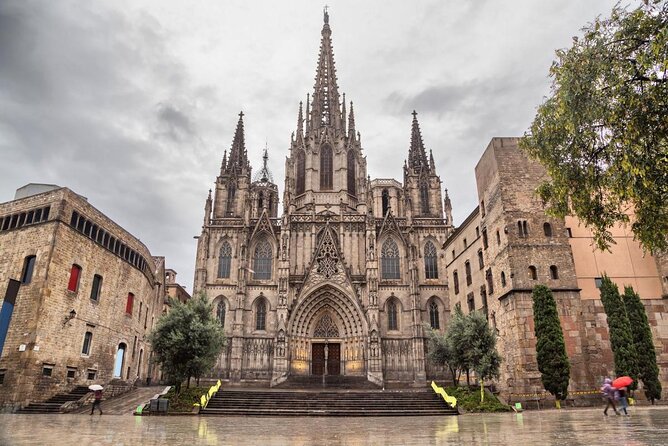
- Medieval Barcelona, in an order that makes sense: Roman walls, Gothic landmarks, then the quiet royal and neighborhood squares.
- Included pintxos and a drink: you’ll eat like Barcelona, not like a vending machine in a hurry.
- A guide with multiple languages: English, Spanish, French, and Italian.
- Free entry for every listed stop: you’re paying for guidance and food, not museum tickets.
- Small group feel: capped at 20 travelers, so questions don’t get lost.
Why the Gothic Quarter Feels Easier After This 2.5-Hour Walk
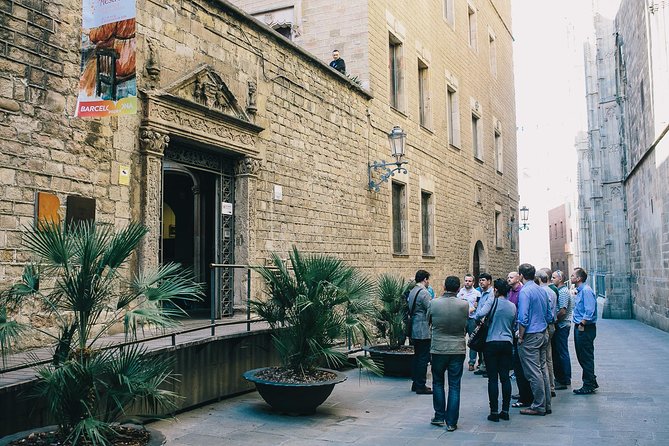
Barcelona’s Gothic Quarter can feel like a maze. That’s part of the charm. Still, without a guide, it’s easy to miss what connects the places—Roman foundations, medieval power, and the day-to-day life that shaped the streets.
This tour helps you get your bearings fast. You’re not just looking at buildings; you’re learning how the city’s layers fit together. And because it’s only about 2 hours 30 minutes, it works even if you’ve got limited time in the Old Town.
You can also read our reviews of more tours and experiences in Barcelona.
Price and Value: What You’re Really Paying For
At $54.06 per person, the headline cost sounds simple. The better question is: what do you get for that money?
You get a professional guide plus one pintxo and one drink. You also avoid entrance fees for the listed stops, since the tour’s stops are marked as admission ticket free. In other words, you’re paying mainly for interpretation—someone to point out what matters and why.
No hotel pickup either, so the value is best if you’re already comfortable making your own way to the meeting point.
Starting at Lamaro Hotel: Simple Meeting Point, One Main Tip
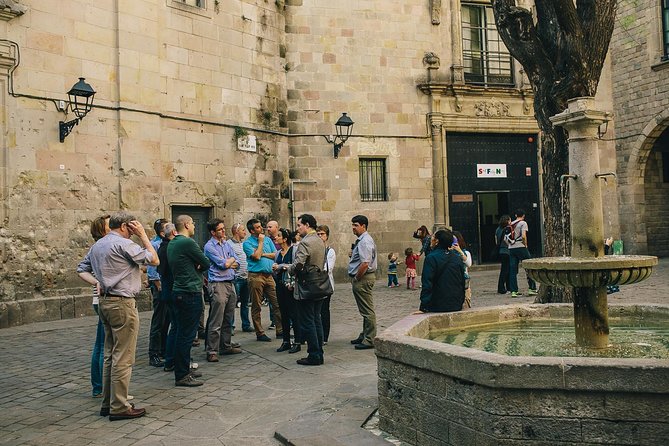
The tour meets at Lamaro Hotel Barcelona (Av. de la Catedral, 7), in Ciutat Vella. The schedule starts at 3:30 pm, and the walk ends back at the same place.
In a review, people noted the guide was easy to spot with a red umbrella. If the street around the meeting point looks crowded, keep scanning for that umbrella rather than trying to guess where the group is already standing. A few minutes late can make it harder to catch up.
Plaça Nova and Joan Brossa’s Barcino Letters
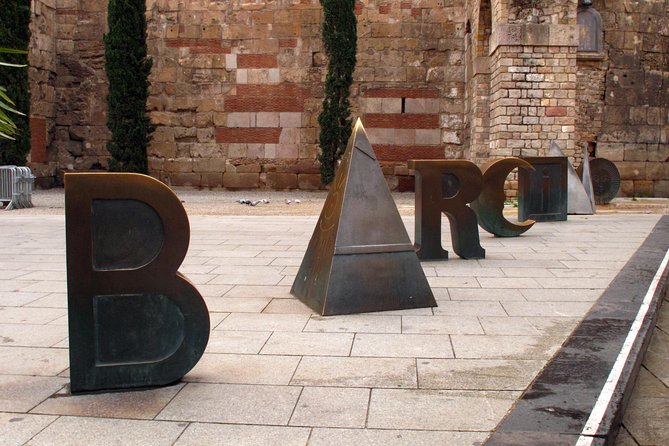
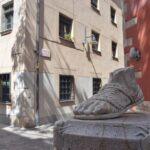
You start at Plaça Nova, where seven giant letters sit against the historic backdrop. They spell Barcino, the principal name for the Roman colony that became today’s Barcelona (Colonia Iulia Augusta Faventia Paterna Barcino).
What I like about this opening is that it gives you a theme right away: the city has never been one single time period. These letters were created by Joan Brossa—six bronze and one aluminium—so you get a mix of modern art talking to ancient walls.
Practical tip: take a minute here for photos, then keep moving. This area is gorgeous, but the best part is what comes next.
Catedral de Barcelona and the Portal del Bisbe Area
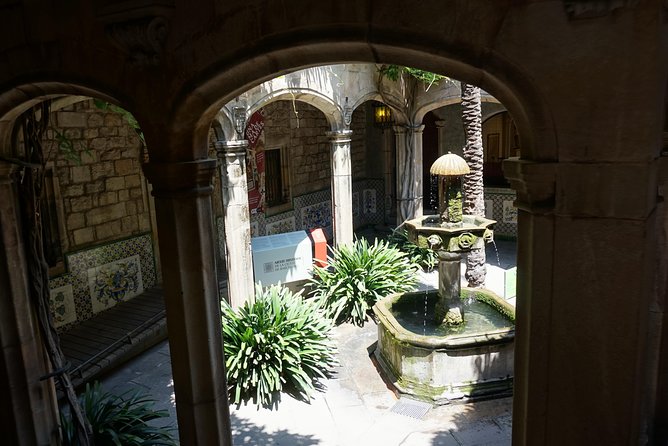
Next you head toward the Catedral de Barcelona area (often described as the Palace of the Bishop). The point isn’t just the modern skyline view—it’s what sits underneath and around it.
You’ll hear how this episcopal complex rises within the walled city, using utensils and material tied to Roman-era structures. It’s a great moment to notice how medieval Barcelona reused what came before.
Then you’re guided through the New Square in front of the Portal del Bisbe, also connected to the Roman walls. The New Square was shaped in 1355 when water was channeled from Collserola, with buildings demolished to open the view facing the portal area.
If you like cause-and-effect history, this stop delivers.


Casa de l’Ardiaca: From Ecclesiastical Residence to Romeo-and-Juliet Balcony
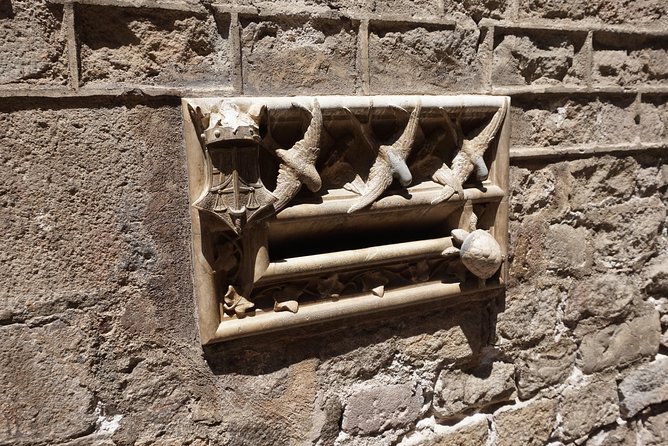
Casa de l’Ardiaca is a standout because it’s not just a church-adjacent building. It was the residence of the ecclesiastical hierarchy starting in the 12th century, then it changed over time.
In the early 16th century, alterations connected it with the dean’s residence, and the porticoed central courtyard was added. You’ll also see Renaissance-style decoration layered onto the original flamboyant Gothic feel. It’s a reminder that these places weren’t frozen in time.
And yes, there’s a staircase that leads to an upper terrace, with a balcony described in Romeo and Juliet terms. It’s a small visual moment, but it helps you picture how the elite moved through these spaces.
Placa Sant Felip Neri: A Tiny Square with Big Contrasts
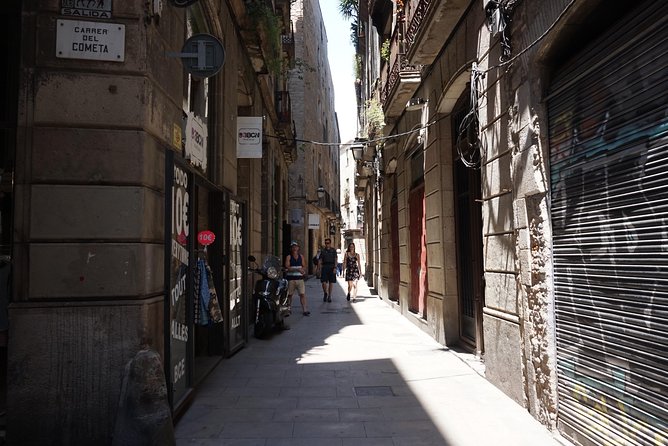
Placa Sant Felip Neri is where the Gothic Quarter’s narrow lanes suddenly open up. You get a small square with a charming fountain in the middle, watched over by the baroque church of Sant Felip Neri.
A neat detail here is the window into older crafts. One side shows buildings that housed the city’s shoemakers’ and coppersmiths’ guilds, with those guilds having moved from premises on Carrer de la Bòria and Carrer de la Corribia.
This is the kind of stop where you realize medieval life wasn’t only nobles and bishops. It was tradespeople, too.
Placeta del Pi: The Church and the Artist Squares
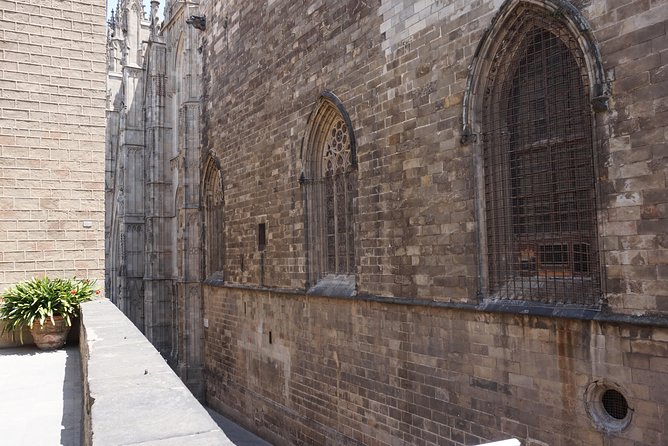
Placeta del Pi brings you to a Gothic basilica and two picturesque surrounding squares. Here’s where the setting shifts from power to everyday creativity.
The old cemeteries around the 14th-century church have become small squares where painters and artisans show their works. Even if you don’t buy anything, it’s a good moment to slow down, look around, and remember that the old urban fabric is still used—not just displayed.
Practical tip: if you want photos, this is a friendly place to pause without feeling like you’re blocking the tour.
Plaça del Rei: Royal Palace Walls and a Peaceful Medieval Enclosure
Plaça del Rei is one of the most satisfying stops on the route. The Conjunt Monumental de la Plaça del Rei includes the royal palace, Palau Reial Major, plus surrounding buildings that enclose a harmonious, peaceful square.
You get that sense of medieval Barcelona as a designed space, not only random alleyways. This is the kind of location where you can feel how civic and royal life shared the same neighborhood.
It’s also a good contrast point. Earlier stops are about layers of stone and craft. Here the focus is on how power was staged—and how it shaped the streets.
MUHBA Temple d’August: Four Columns That Refuse to Go Away
Then you hit MUHBA Temple d’August, one of those Barcelona moments that feels like a secret even though it’s right there on Carrer Paradís.
Inside a small medieval courtyard, you’ll see four columns from the Temple of Augustus. They’ve survived for more than 2,000 years. That’s the kind of fact that changes your perspective. It’s not just that the city is old; it’s that pieces of the ancient city literally remain part of daily space.
This stop works best if you let yourself stand still for a minute. Don’t rush the photos. Look at the columns, then look around the courtyard and notice how medieval architecture holds the ancient pieces inside.
Santa Maria del Mar: The Old Town Cathedral Built by Neighbors
Basilica de Santa Maria del Mar is widely considered the real cathedral of the Old Town because it was founded and constructed in medieval times by people from the neighborhood itself.
That neighbor-built detail matters. It turns the building from an impressive object into a community project. You see a Catalan Gothic emblem in stone, shaped by local hands and local needs—not only by distant authority.
If you’re the type who likes to understand why buildings look the way they do, this is a strong stop. And if you’re simply tired from walking, Santa Maria del Mar is also a great place to reset your posture and breathe.
Carrer de Montcada: A Medieval Civic Street With a Romanesque Beginning
The walk also covers Carrer de Montcada, described as the most important area of medieval civic architecture in the city.
It’s structured like a timeline. The street begins with the Romanesque Marcus chapel (12th century) and runs until Plaça del Born. It used to be one single street until the 19th century, when Carrer Princesa was opened in 1853 and split it into two sections.
The name connects to the Montcada family, who reportedly received land in the 12th century to support King Ramon Berenguer IV during the conquest of Majorca.
For me, the value here is that you see medieval civic life as something physical: chapels, streets, land grants, and the architecture that came with social status.
Pintxos and Drinks: How This Tour Keeps You From Getting Hangry
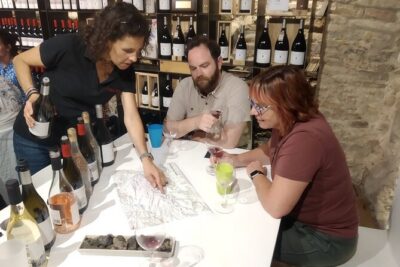
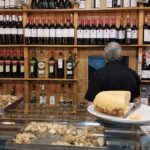
Food is not an afterthought on this tour. You’re provided with one pintxo and one drink.
This is a practical move. You’re doing concentrated sightseeing in the afternoon. Having the meal included means you don’t waste time searching for a place that can handle your schedule and crowd.
If you want a tip for enjoying it more: treat this as part of the tour’s context. Ask the guide about what you’re eating, and take a second to compare the local pintxo style with the broader tapas idea. Even people who don’t eat much will appreciate the break.
Guide Impact: The Real Reason People Rate This So Highly
The best praise in the reviews is about the guides. People repeatedly call out that the guides keep the group moving with stories, facts, and humor—not just a lecture.
I also like that the tour includes multiple language options, so you’re less likely to end up with a guide who can only handle one crowd. In different bookings, I saw guides named Ariana, Leah, Núria, and Maria mentioned, and all of those comments point to the same theme: the person leading you makes the city feel alive.
One review also mentioned a guide going above and beyond by calling an olive oil shop to help select something to bring home. That’s a reminder that the guide isn’t only a walking encyclopedia. They’re also a local connector.
Pace and What to Expect From Group Walking
The tour is a group experience with a maximum of 20 travelers. Reviews describe an easy-to-follow pace and strong attention from the guide, which matters in a neighborhood like the Gothic Quarter where you’re constantly threading past corners.
You’ll get multiple photo opportunities. You’ll also be moving often enough that you should plan to walk, not “hover and browse.” If you’re the type who hates hurrying, this is still manageable because the stops are short and focused, and the tour keeps the flow.
Who This Tour Is Best For
This one is ideal if you:
- Want an orientation to the Gothic Quarter without spending all day getting lost.
- Like architecture and would rather learn why something was built than only admire how it looks.
- Enjoy a social element with a small group, especially if you’re traveling solo or with family.
- Want a guided history walk that ends with a real local break—pintxos and a drink.
It can also work well as a first afternoon in Barcelona’s center, since it gives you a structure you can use when you wander on your own afterward.
FAQ
Where does the tour start?
It starts at Lamaro Hotel Barcelona, Av. de la Catedral, 7, in Ciutat Vella (08002), and the tour ends back at the same meeting point.
What time does the tour begin?
The start time is 3:30 pm.
How long is the tour?
The duration is about 2 hours 30 minutes.
What’s included with the tour?
You get one pintxo, one drink, and a professional guide (English/Spanish and French are listed).
Which languages are available?
The tour is offered in English, Spanish, French, and Italian.
Do I need to pay separate entrance fees at the stops?
The stops listed are marked as free admission ticket locations.
Can I cancel for a refund?
Yes. You can cancel up to 24 hours before the experience’s start time for a full refund.
Should You Book This Gothic Quarter Insights & Tapas Experience?
Yes—if you want a guided Gothic Quarter overview that doesn’t feel dry and includes a real break. The value comes from the mix of medieval landmarks, free entry stops, and the included pintxo plus drink that keeps the afternoon comfortable.
Book it especially if you’re visiting for the first time or if you want your walking time to pay off in context, not just scenery. Just be ready for the main tradeoff: lots of walking on narrow streets, so comfortable shoes aren’t optional. If you’re planning around that, this tour is an easy win.